Farm Operations Management
Seeding in Hydroponics: Tips for Higher Germination Rates and Better Starts
Articles for Farm Operations Managers
Instability in hydroponics often starts not at harvest but right after seeding. Uneven germination rates, variation in seedling size, and slow early growth are things you can never fully recover from downstream.
Seeding may look like a minor step, but in a vertical farm it connects directly to quality, yield, and production scheduling. When germination is uneven, the utilization efficiency of your growing racks and the reliability of your shipment projections both fall apart.
This article covers seed germination mechanics, temperature and humidity and light management, growing medium selection, and standardizing seeding work — covered in the order you’d work through them in practice.
Seeding’s Place in the Growing Process
Seeding is part of the cultivation workflow, and at the same time the starting point that drives vegetable quality and yield in a major way. Because everything downstream depends on how well this step goes, it is the foundation.
When seeding is done right, germination timing lines up and seedling size becomes uniform. If the environment immediately after germination is managed correctly, root system development is promoted, producing strong seedlings with high nutrient and water uptake capacity. Adaptability to environmental changes improves, and the risk of poor growth and disease also drops. When early growth goes well, the balance of secondary metabolite production is good, which affects nutritional value and flavor too.
Especially in a managed environment like a vertical farm, quality differences at the seeding stage have a large effect on the final harvest — on taste, appearance, and shelf life. A small difference early on shows up as a clear quality difference later in the growing cycle.
Understanding Seed Germination
To make seeding work, you need to understand the mechanism by which seeds actually sprout.
The Physiological Process from Seed to Sprout
Germination proceeds through three stages.
① Imbibition (24–48 hours)
Dry seeds absorb moisture and swell. In hydroponics, excessive water supply causes oxygen deficiency, so water level adjustment is required.
② Metabolic Activation (12–24 hours)
Enzymes that were dormant inside the seed activate, and stored reserves (starch and lipids) are broken down into building blocks for new cell growth. Oxygen consumption rises sharply. Adequate oxygen supply to the growing medium is especially critical at this stage.
③ Radicle Emergence and Germination (1–7 days)
The hypocotyl and radicle break through the seed coat and emerge. In most cases, the root (radicle) emerges first, after which the hypocotyl elongates and the cotyledons unfold. When the right environment is in place, germination is faster and more uniform than in soil.
Germination requires three elements: moisture, oxygen, and appropriate temperature. In hydroponics, balancing moisture and oxygen is both the most difficult and the most important point.
Seed Characteristics Suited to Hydroponics
In hydroponics, not all seeds germinate and grow the same way. The characteristics of seeds that work well include: a seed coat that allows moisture to pass through at an appropriate rate; varieties where the time from germination to the first true leaf is short; a high germination rate of 90% or more; and high early production of root hairs. Even within the same vegetable, hydroponic suitability varies by variety, so choosing varieties based on these characteristics leads to more stable growth.
Why Vertical Farms Grow Mostly Leafy Greens: The Business Logic Behind the Crop Choice
Why Lettuce Dominates Vertical Farm Production
Creating the Optimal Germination Environment
Creating the right germination environment in hydroponics is more delicate than in soil. Small differences in environmental conditions directly affect germination rates, so you need to manage temperature, humidity, and light individually.
Setting Temperature, Humidity, and Light to Optimal Conditions
Temperature Management
Temperature is the most important factor governing germination speed and uniformity. The baseline temperature range for most vegetable seeds is 18–25°C, but the optimum varies by crop: lettuce types at 15–20°C, komatsuna and mizuna at 20–25°C, basil and herbs at 22–28°C. When germination is running late, temperature mismatch is worth suspecting as one cause.
Humidity Management
Maintain 80–90% humidity in the early stage to promote moisture absorption by the seeds, then step it down to 70–80% after germination is confirmed to reduce disease risk. Covering with a dome immediately after seeding and gradually opening it after germination is the standard approach to cover management. Sudden humidity changes kill seeds mid-germination, and prolonged high humidity triggers mold — manage in parallel with appropriate air circulation.
Light Conditions
The most important points in light management after germination are not delaying the start of light exposure and ensuring sufficient light intensity. 14–16 hours of light exposure promotes early growth. When using a cover, light tends to be insufficient — and for light-requiring seeds, germination itself won’t occur without light — so design the balance between cover management and light supply with this in mind.
Growing Medium Selection and Preparation for Better Germination
In hydroponics, the selection and preparation of the growing medium is a critical factor in germination success.
| Growing Medium | Water Retention | Aeration | Ease of Use | Cost | Environmental Impact |
|---|---|---|---|---|---|
| Rockwool | ★★★★ | ★★★ | ★★★★ | ★★ | ★ |
| Polyurethane Foam | ★★★ | ★★★★ | ★★★★★ | ★★★ | ★★ |
| Coco Peat | ★★★★★ | ★★ | ★★★ | ★★★★ | ★★★★★ |
| Vermiculite | ★★★ | ★★★★ | ★★ | ★★★ | ★★★★ |
| Perlite | ★★ | ★★★★★ | ★★ | ★★★ | ★★★ |
For hydroponics beginners, polyurethane foam is a proven recommendation — easy to handle and consistently reliable. In choosing a growing medium, use these three criteria: matching to the root system characteristics of your crop (softer medium for crops with delicate roots); compatibility with your growing system (rockwool or foam for NFT systems); and balancing work efficiency with economics.
Efficient Seeding in Practice
No matter how well you understand germination mechanics and environmental conditions, high germination rates won’t follow if the seeding work itself isn’t precise. Seeding in hydroponics demands a delicacy different from soil, and how you handle each individual seed affects the harvest volume and quality that follow.
Seeding Technique: Accuracy and Speed Together
Seeding work requires a balance of precision and speed. The basics of accurate seeding start with: maintaining a posture that holds up through long work sessions; setting the seeding table height to the operator’s elbow height; and ensuring enough brightness to see your hands clearly. Use tweezers and seeding tools matched to seed size, and match the seeding plate to seed size as well. Tips for uniform seeding:
- Align the orientation of seeds (especially flat seeds)
- Set appropriate seeding depth (2–3 times the seed size as a baseline)
- Handle coated seeds carefully so the outer coating doesn’t break off
Workflow Design to Improve Efficiency
Improving seeding efficiency requires designing the overall work flow, not just individual technique.
Thorough Pre-Work Preparation
Check and lay out all materials in advance: seeder, tweezers, growing medium (foam), seeding trays, foam trays, rubber gloves (long). Determine the placement of each material and the operator’s working position based on workflow, and always confirm the variety and the number of trays to seed.
Establishing Standard Operating Procedures
Standardizing seeding work is essential for achieving both quality and efficiency.
Growing medium saturation:
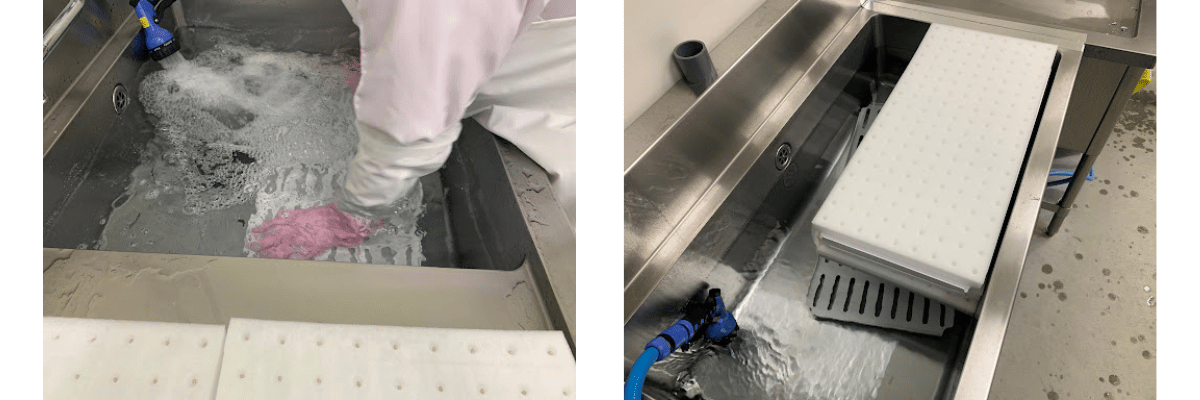
- Saturation preparation
- Fill with water
- Saturate the growing medium
Seeding:
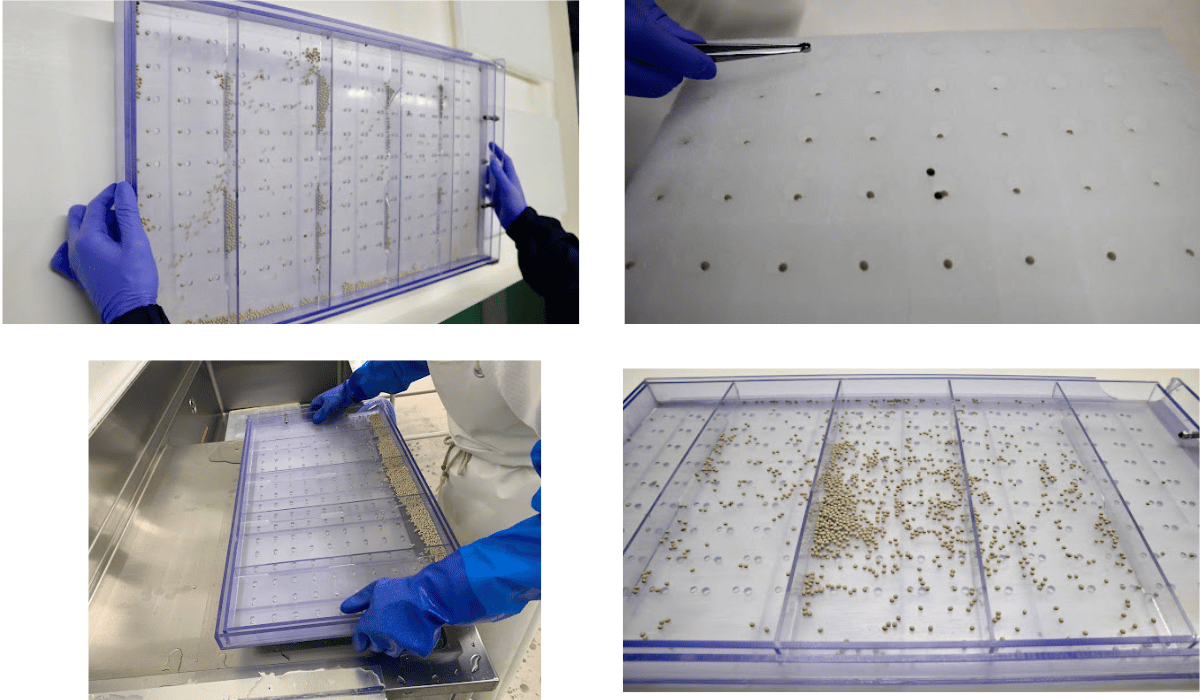
- Remove saturated foam
- Spread seeds evenly throughout the seeder
- Hold the seeder with both hands and shake it gently in all directions to fill all the depressions with seeds
- Align the holes in the foam with the holes in the seeder, pull the slider to drop the seeds
- Use tweezers to adjust the position of seeds on the foam (careful not to break the coating)
Watering:
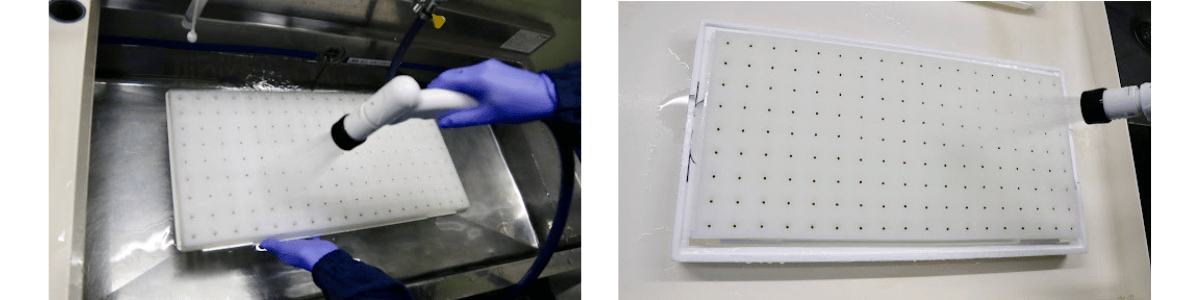
- Time the watering — water only long enough to ensure seeds are thoroughly wet
- Water the entire growing medium evenly with no dry spots
Points for Improving Efficiency
- Separate preparation from the main work: Complete preparation tasks before seeding as a distinct step, and run the main seeding work continuously without interruption
- Optimize workflow layout: Arrange the work table and materials to minimize unnecessary movement. Adjust layout for right- or left-handed operators and set table height to reduce fatigue
- Clear role assignment: When working with multiple people, divide roles: “medium preparation,” “seeding,” “watering,” and so on
- Error-proofing: Use pointing-and-calling checks (pointing physically and saying it aloud) to confirm the variety matches the work plan, and standardize how materials and seed packets are arranged to reduce time searching for what you need
In large production facilities, analyzing operator movement to reduce unnecessary travel can deliver significant efficiency gains. Improving seeding is not just about manual dexterity — the perspective of designing the entire work flow is what determines results.
Post-Germination Propagation Care
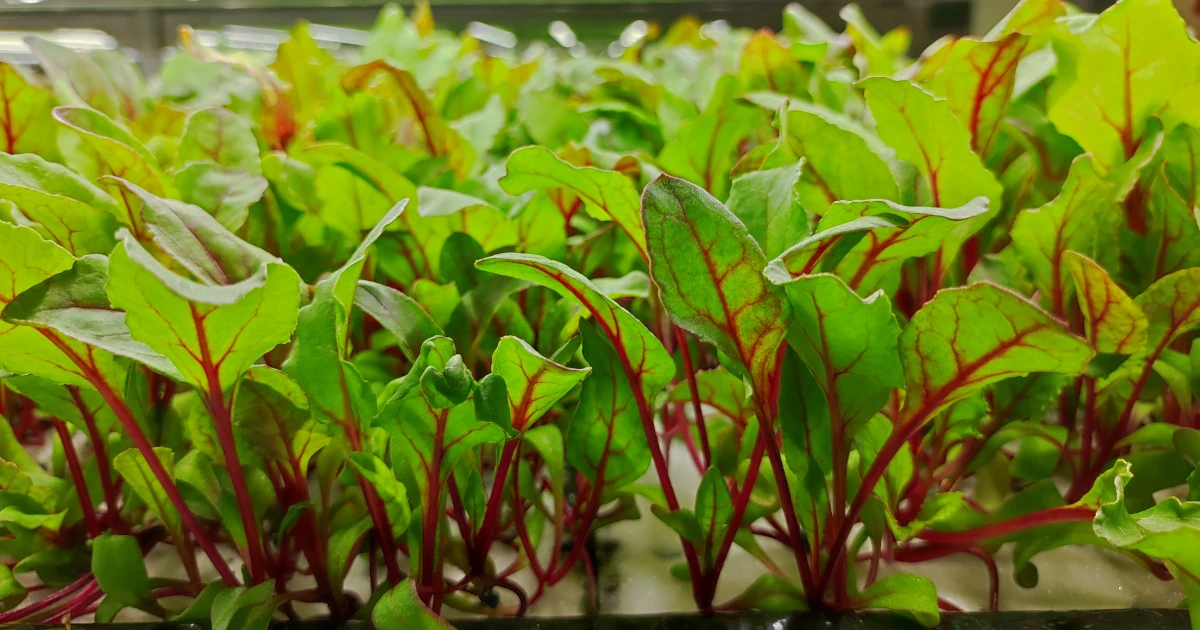
Post-germination propagation care is as important a stage for hydroponics success as germination itself. Even with high germination rates, neglecting management during this period means seedlings won’t grow into healthy plants, which affects the final harvest. In hydroponics, plants are more sensitive to environmental changes than in soil, so more careful and planned care is needed.
Growth Stage Management from Cotyledon to True Leaf
The period from immediately after germination to true leaf development is one of the most delicate in a plant’s life. The humidity cover is there to hold the moisture seeds need. Remove it when about 80% of the seedlings have germinated. Leaving the cover on prevents seedlings from getting adequate light and stunts growth, and also raises the risk of disease from excessive moisture. For light, secure sufficient intensity to prevent legginess; for water, manage to avoid both waterlogging and drying out. Maintain temperature within the appropriate range for each crop; provide nutrient solution at appropriate concentration to promote root development.
Identifying Healthy Seedlings and Selection Technique
| Criterion | Healthy State | Problematic State |
|---|---|---|
| Plant height | Standard height for the variety, uniform across the population | Extreme elongation or stunting |
| Stem thickness | Full, thick, firm stems | Thin from legginess, or abnormally thick |
| Leaf color | Deep green (depending on variety) | Pale, yellowing, purple coloration |
| Leaf shape | Flat and turgid | Curled or crinkled |
| Root condition | White with many branches | Brown, black, or foul-smelling |
| Root volume | Extending sufficiently from the growing medium | Too few roots, or excessive |
| New root emergence | Many new roots visible at the root tips | Few or no new roots visible |
| Leaf color uniformity | Uniform coloration overall | Spots, discoloration, uneven color |
| Population uniformity | Small standard deviation | High variability |
Best Timing and Approach for Transplanting
Timing and method of transplanting have a major effect on establishment and growth after final planting. The optimal timing for transplanting is judged by the degree of leaf overlap. The appropriate window is when the leaves of adjacent seedlings start to overlap — if you wait until the overlap becomes severe before transplanting, seedlings will become leggy. When propagation care has been done right, growth after transplanting proceeds smoothly and leads to improved final harvest volume and quality.
Daily Management and Troubleshooting
Daily close observation and response are essential for managing seeding and germination in hydroponics. Good daily management prevents most problems before they occur and allows rapid response to those that do appear. Germination failures break down broadly into two types: problems with the seed itself and problems with environmental factors.
Common Germination Problems and Responses
| Issue | Primary Cause | Response |
|---|---|---|
| Low germination rate | Seed quality degradation, temperature mismatch | Check seed freshness, maintain proper temperature |
| Uneven germination | Uneven moisture, seed variability | Uniform watering, seed selection |
| Legginess (elongated seedlings) | Insufficient light, high temperature | Secure adequate light intensity, temperature management |
| Root rot | Overwatering, poor drainage, pathogens | Appropriate water management, use clean equipment |
| Mold | High humidity, poor airflow | Appropriate ventilation, humidity adjustment |
Two hydroponics-specific problems deserve particular attention: oxygen deficiency from excess moisture (symptoms: seed rot, poor rooting / response: adjust moisture level in growing medium and confirm drainage); and uneven germination from temperature variation (symptoms: germination in only some areas, variation in germination timing / response: check temperature distribution in the propagation room and install a circulation fan). In both cases, early detection and early response are most important — making daily observation a habit so small changes aren’t missed is the prerequisite.
Proper Seed Storage and Inventory Management
Seeds maintain their vigor when kept in the right storage conditions. The basics are: temperature 4–10°C, low humidity 30–50%, an airtight container, and light-blocking storage (especially for photoblastic seeds). For inventory management, follow three rules: lot tracking (recording purchase date and lot number), setting expiration dates by seed type, and first-in, first-out (FIFO). Poor storage causes vigor loss that isn’t visible from the outside, only surfacing later as germination failure — so storage environment management must be ongoing.
The Business Impact of Better Germination Rates
Improving germination rates is not just a technical achievement — it has direct business effects. A rise from 90% to 95% germination reduces seed usage by roughly 5%, meaning a facility using 10 million seeds per year saves approximately ¥1 million in annual seed costs. Downstream benefits include: improved labor productivity from fewer backup seedlings; more stable production planning from securing the planned number of plants for final planting; and improved accuracy of shipment forecasts. And as growth variation drops, the volume of unmarketable produce also drops, with a real contribution to revenue.
When these effects stack up, they translate into business improvements on the order of several million yen per year. The recognition that careful management at the seeding stage affects the profitability of the entire operation is also important for setting farm operations management priorities.