Crops
Why Vertical Farms Grow Mostly Leafy Greens: The Business Logic Behind the Crop Choice
The reason leafy greens dominate vertical farms is not coincidence or convention. It’s because the cost structure of the facility and the growing characteristics of leafy greens fit together.
In Plant Factories with Artificial Lighting (PFAL), light, HVAC, equipment, and labor all weigh heavily on production costs. What matters most in that context is being able to harvest quickly, having a high edible portion, and responding well to environmental control.
This article examines why leafy greens like lettuce and spinach are well-suited to vertical farms — from both a biological and a financial standpoint.
What Makes a Vertical Farm Different
A vertical farm is a facility that can artificially control environmental conditions like temperature, humidity, light, and CO2 concentration. Because it operates almost entirely independent of outdoor conditions, it can produce crops year-round on a planned schedule. That’s what sets it fundamentally apart from open-field farming and other forms of protected cultivation.
Why Leafy Greens Are a Natural Fit for Vertical Farms
The core reason vertical farms are well-suited to leafy greens lies in the growing characteristics of leafy greens and their high edible portion.
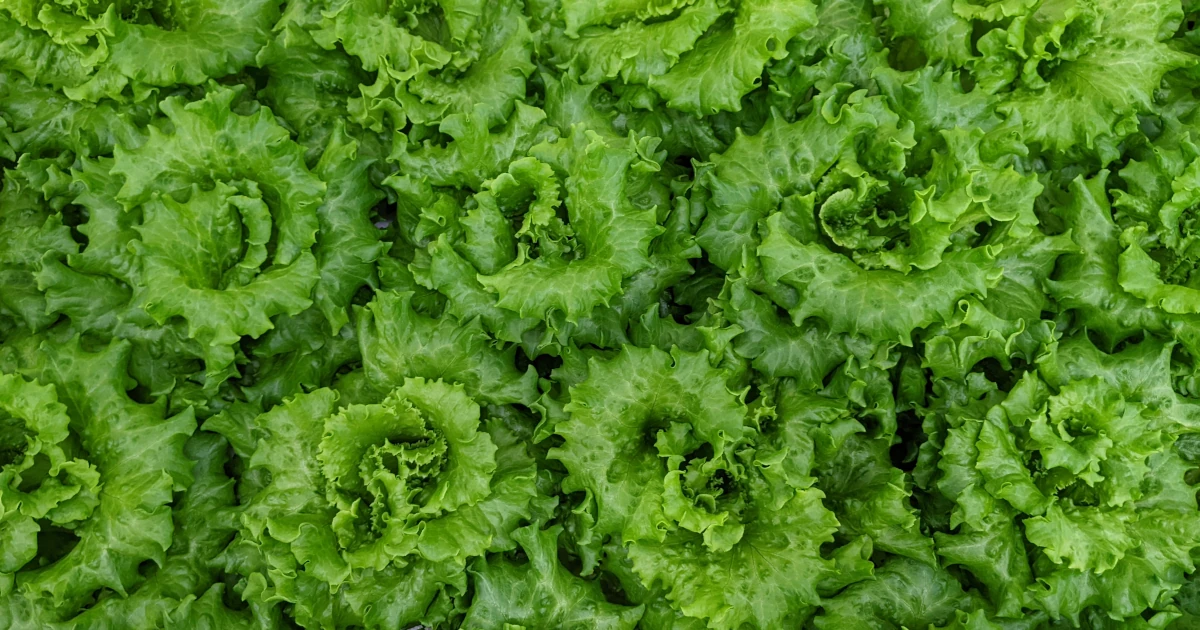
Leafy greens are plants where the leaves are the primary edible part, and the leaves make up a large share of the plant overall. Nearly the entire harvested plant — everything except the roots — can be sold. From a facility cost perspective, this is a critical characteristic. Leaf growth is also fast, so the time from seeding to harvest is just 30 to 40 days. That combination — high edible portion and fast growth — is what makes leafy greens ideal for year-round cultivation and multi-tier growing in vertical farms.
The Cost Structure Match
Operating costs in vertical farms are extremely high, and LED lighting electricity costs weigh heavily on production. Light is what drives leaf growth, but light costs money.
This is the key point: for fruiting crops like tomatoes, where you use light to grow leaves but ultimately sell the fruit, it’s difficult to recoup the cost of that vegetative growth through the fruit’s selling price. In a vertical farm, if you can’t harvest a large edible portion quickly through a short growing cycle, it’s hard to break even — and crops that grow slowly or have a large non-edible portion go into the red fast.
For crops that don’t work well in vertical farms, see the articles below. Grains and root vegetables aren’t impossible to grow, but they share one thing in common: “there’s almost no advantage to growing them in a vertical farm.”
Why Vertical Farms and Root Vegetables Don’t Mix — An Explanation
Rice and Vertical Farms: Can You Grow Rice Hydroponically? A Business Perspective
The 3 Conditions a Crop Needs to Work in a Vertical Farm
The conditions for a crop to work in a vertical farm come down to three things: it can be harvested quickly with high yield per unit area, it has a large edible portion, and it responds well to environmental control. Leafy greens meet all three.
Take lettuce as an example: the time from seeding to harvest is just 30 to 40 days, year-round production is possible through in-facility environmental control, and almost everything except the roots is edible. On top of that, controlling the growing environment offers room to adjust nutritional content — vitamins and minerals — which is a unique trait of leafy greens.
Beyond leafy greens, some fruits are also well-suited to vertical farms. See the article below for details.
Even With Leafy Greens, Frontline Capability Is Non-Negotiable
High initial investment and operating costs are the defining challenge of vertical farms. Capital costs for construction, HVAC, and lighting are large, and electricity and other running costs are steep. It’s not uncommon in this industry to see businesses go into the red from cost overruns, then shut down or go bankrupt. After years in the field, I’ve watched more than a few companies go through exactly that.
You can grow leafy greens and still operate at a loss. That’s how hard this business is. At the same time, there are farms consistently generating solid profits. In my experience, what those farms have in common is a high level of technical skill among their frontline staff. To achieve profitability, you need a systematic understanding of what actually works.
172 Tips for Improving Vertical Farm Profitability
Summary
The reason leafy greens are chosen for vertical farms comes down to the fit between cost structure and growing characteristics. The properties of leafy greens — fast harvest cycles, high edible portion, and responsiveness to environmental control — match the economic reality of vertical farms, where initial investment and electricity costs weigh heavily.
Flip that logic around, and it explains why grains, root vegetables, and most fruiting vegetables are difficult to make profitable even when they can be grown. Crop selection is a fundamental business decision that determines a vertical farm’s profitability — and it needs to be evaluated not just on agronomic suitability, but on the ability to recover costs.
Recently, wasabi has been attracting attention as a high-value crop said to work well within the controlled environment of a vertical farm.
Can Wasabi Be Grown Hydroponically in a Vertical Farm? Yes — and the Fit Is Better Than You Think