Vertical Farm Basics and Overview
Reading the Deficit Structure of Vertical Farms: What "60% in the Red" Really Means
The figure that “many vertical farms are in the red” does point to how tough the industry is. But read that number in isolation—as if every operator were being blindsided by failure—and you will misread what is actually happening.
Vertical farms carry a heavy initial investment, and once you include depreciation and the ramp-up period, they are structurally hard to make profitable in the opening years. The real question is not the red ink itself, but which losses fall within plan and which ones are eroding the viability of the business.
In this article, drawing on survey data, I break down the revenue structure of vertical farms—yield, scale, labor costs, utilities, sales channels, and subsidy dependence—sorting out the issues that hide behind that single word “deficit.”
Deficits are factored in from the day the business starts
One point that is not written clearly on most sites is that operators of vertical farms assume, from the very beginning, that the early years after opening will be a stretch of losses or thin margins. In a vertical farm, where capital investment is large, it is structurally difficult to generate substantial profit during the years in which depreciation is still running. Operators start their businesses having already priced in the possibility of being in the red for the first several years.
Of course, there are cases where losses run beyond plan, or where sales fall short of expectations. But the phrase “vertical farm deficit” does not always mean “management has unexpectedly gone off the rails.” Losses during the depreciation period are often within plan, and you cannot talk about the whole picture without looking at what the red ink actually consists of.
The explanations you see on many sites under the heading “Why are vertical farms in the red” — which list only lack of know-how, failed sales strategy, and rising running costs as the causes — miss this structural premise.
The current state of revenue: data that shows a harsh reality
The difficulty of making vertical farms profitable is clearly visible in the data as well. Surveys show that roughly 70% of vertical farms are running losses or breaking even, and many facilities cannot keep operating without subsidies.
| Greenhouse | Hybrid | PFAL | |
|---|---|---|---|
| Most recent results (loss or break-even) | 55% | 77% | 84% |
| Annual revenue (average) | JPY 490 million | JPY 270 million | JPY 160 million |
Greenhouses have a higher share of profitable operations than PFALs (plant factories with artificial lighting), and their annual revenues are larger as well. On profitability, the data points to greenhouses being in a more favorable position.
On subsidies, 63% of greenhouse operations are using some form of energy-related subsidy, while 27% of facilities overall operate without any subsidy. For PFALs, 48% operate without subsidies — another signal of how hard it is for PFALs to secure revenue on their own.
The difficulty of profitability is not limited to Japan. AeroFarms in the United States, which drew attention as “one of the world’s largest vertical farms,” is, as of April 2026, still seeing its closure deadline pushed back as the sale of its facilities keeps being delayed. Even companies that built out advanced facilities on abundant funding cannot clear the profitability wall. That is the reality.
There is another risk attached to dependence on subsidies: the moment they are cut off. The Swedish hydroponics startup Hydro Space Sweden AB had built up sales channels with local supermarkets and had even obtained a government-guaranteed loan. Even so, when its subsidy was abruptly ended in 2026, the company was driven into a management crisis, and the founder was forced to choose between selling the company and going bankrupt. Whether an operator can build an independent revenue structure while the subsidy is still in place has become the lifeline of the vertical farm business.
What insiders will never say… the real challenge of vertical farms is that “people do not stay”
Why they run into deficits: reading it from the data
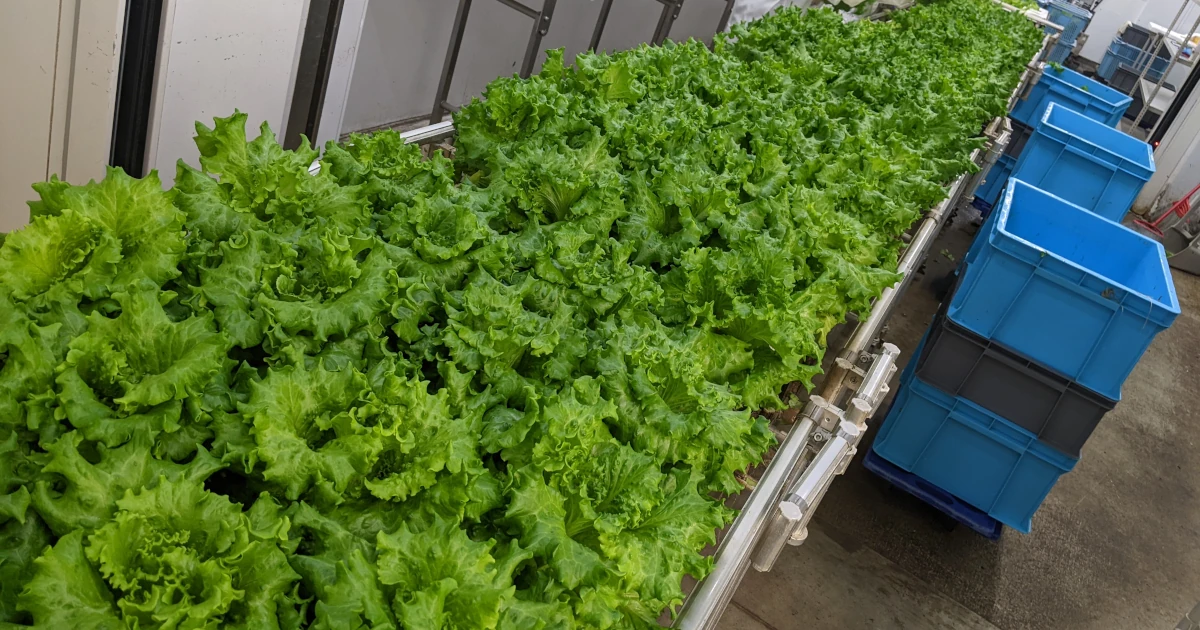
Below, I sort through the common factors behind the losses, based on the data.
1. The higher the productivity per unit area, the more likely the operation is to be profitable
A clear correlation between yield per area and profitability shows up in the surveys as well. For greenhouses, 27.3 kg/m² per year is the benchmark; for PFALs, it is 59.5 kg/m² per year. Facilities that clear these figures tend to be profitable. Getting more harvest out of the same floor area requires a deep understanding of plant physiology and the know-how to actually run the equipment.
Beyond yield, the scale of the facility itself affects profitability. For both greenhouses and PFALs, the larger the cultivation area, the higher the share of operators that are profitable or at break-even. Economies of scale clearly contribute to revenue.
2. The higher the labor and utility costs, the deeper the losses
Across every type of vertical farm, labor and utilities are the main cost items. Operators with a higher labor-cost ratio are more likely to be in the red, and because PFALs carry a heavy electricity burden in particular, whether or not you can hold utilities down decides a large part of the revenue picture. Put the other way, if you can hold these two items down, the path to improved revenue becomes clearly visible. But to actually realize those cost reductions, the technical skill and know-how of frontline staff is indispensable.
Running costs are expected to stay under upward pressure going forward. Materials, electricity, labor — there is little basis to expect any of them to come down, and thorough cost control will continue to be required.
3. The fewer the trading partners, the deeper the losses
Operators who have diversified their sales channels — combining contract growing, direct sales, and e-commerce — tend to be profitable. As the number of trading partners grows, negotiating power on price rises and the risk of dependence on a single buyer falls. That said, operators with broad sales channels often also have larger facilities to begin with, so the scale effect needs to be separated out when you read the numbers.
4. It takes time for the business to stabilize
Among facilities that started operating from 2019 onward, 72% are currently running losses — a sharp illustration of how hard it is to generate enough profit during the depreciation period. Right after launch, it also takes time to develop sales channels and to stabilize the frontline, so early-stage losses are structurally hard to avoid. On the other hand, even operators that entered the industry in its early days are not always profitable. There are cases where, even after depreciation has ended, facilities cannot push productivity far enough with their aging equipment — entering early does not, by itself, lock in a durable advantage.
Summary
Once you lay out the revenue structure of vertical farms, it becomes clear that the cause of losses is not a simple matter. What matters first is separating planned losses from losses that threaten the continuation of the business, and that judgment requires looking at several factors together: yield, scale, cost structure, sales channels, and the degree of subsidy dependence.
The clearest trend in the data is the correlation between yield per area and profitability. Scaling up facilities certainly works in your favor, but beyond that, it is the day-to-day precision of crop management and the technical level of frontline staff that really decide revenue. The same applies to cost control — actually holding down labor and utilities first requires lifting the capability of the people on the floor.
Running a business that depends on subsidies can deliver short-term stability, but it always carries the risk of those subsidies being cut. Whether you can build an independent revenue structure while the subsidy is still there is the turning point for long-term survival. The outlook for vertical farms is, in reality, harsh. But the operators who keep layering steady improvements — in crop management and in the diversification of sales channels — are the ones who hold the possibility of clearing that wall.
[Free] 13 templates used in farm operations management for vertical farms