Farm Operations Management
How to Build a Crop Schedule for a Vertical Farm: Designing Across Demand, Production, and Operations
Articles for Farm Operations Managers
Revenue in a vertical farm is not decided by cultivation technique alone. The precision of the plan — when, what, to which specification, and how much you produce — has a large impact on waste and lost opportunity.
Equipment area, labor, days to harvest, and sales volume look independent, but in practice they are all tied together in a single schedule. When any one of them slips, it spreads to harvest volume, quality, and the workload on staff.
This article lays out the basic elements a farm operations management lead needs to build a crop schedule, along with the thinking behind process design, capacity calculation, and workload leveling.
Why a crop schedule matters in vertical farm management
A crop schedule is the concrete decision of “when,” “what,” and “how much” you will produce. Producing to match demand keeps waste and excess inventory down, and leveling the work stabilizes staffing and cuts overtime. Planned environmental control also ties directly to consistent quality.
If you run seeding and harvest ad hoc without a crop schedule, you miss sales when demand runs above plan, and you generate waste when it runs below. On top of that, when work piles up on specific days, labor cost rises and quality drifts. All of these hit revenue directly.
Three basic elements behind a crop schedule
To build an effective crop schedule, you have to be clear on the following three elements.
1. What will you grow? — Choosing crops that match the market
When you decide which crops to grow, you weigh the following factors together.
| Criterion | Points to consider | Concrete sources |
|---|---|---|
| Market demand | Consumer needs, trends | Retail store surveys, wholesale market data, social media analysis |
| Cultivation fit | Adaptability to the environment, growth traits | Technical references, case studies from other farms, trial cultivation data |
| Profitability | Unit sales price, cultivation cost, turnover rate | Cost accounting, market price trends, competitor analysis |
To hold down initial investment, choosing varieties with a short cultivation cycle and low pest-and-disease risk reduces the risk of failure.
2. To which specification will you ship? — Balancing quality and price
A vertical farm can supply high-quality vegetables on a stable basis, but the higher you set the quality bar, the more production cost rises. Based on market research, you set product specifications that factor in both customer needs and price competitiveness.
For example, typical specification patterns for leafy greens:
- Size categories: S / M / L and so on (leaf length or overall plant size)
- Weight specification: e.g., leaf lettuce at 80 g ± 5 g per plant
- Quality criteria: leaf color (deep green), shape (well-formed leaves), freshness (within X days of harvest)
The right specification depends on your main target (mass retailers, restaurant chains, high-end restaurants, and so on). It is important to interview your buyers and set specifications that balance their requests against production efficiency. Restaurant chains tend to prioritize uniformity; high-end Japanese restaurants tend to prioritize visual beauty.
3. How much will you produce? — Balancing equipment capacity against demand forecasts
Production volume ties directly to revenue and is a critical decision. You set it by weighing four points: equipment capacity (cultivation area, lighting, HVAC), the sales plan (contracted volume, seasonal variation), cultivation efficiency (plant spacing, days to grow, harvest cycle), and your staffing structure (labor efficiency, skill level).
The safe approach is to plan first against “volume you can reliably sell,” then gradually optimize against actuals. Over-production leads to waste; under-production leads to lost opportunity. Especially in the early stages, starting from a conservative plan and expanding as you accumulate actual data is the realistic path.
Balancing these three basic elements — what, to which specification, and how much — is what drives profitability in a vertical farm. The core is to read the balance between market needs and your own production capacity, and to find the combination of crop, specification, and volume that delivers the best return.
[Making a vertical farm profitable] A practical guide to strategic crop scheduling and process design
The most important point for succeeding in the vertical farm business is this: do not produce blindly — produce strategically. In this section, we walk through crop scheduling and process design that lead to profitability, in a form that a farm operations management lead can put into practice starting tomorrow.
1. The full picture of a strategic crop schedule
A crop schedule in a vertical farm is built on three axes: matching market needs with your own technical strengths (what to grow), designing efficient production processes (how to grow), and optimizing the timing of supply against demand (when and how much to grow). Only when all three axes mesh do equipment utilization and profitability rise together.
2. Building a production plan that starts from the market
The key to profitability is not thinking like a production plant (“make what we can make”) but thinking like marketing (“make what will sell”). As a practical step, you first grasp demand from existing and potential customers by interviewing buyers, gathering consumption trends, and researching competitors. Then you build a concrete sales plan using the formula below.
Sales plan = base demand volume × seasonal coefficient × growth target coefficient
Worked example: lettuce
- Base demand volume: 5,000 plants/day (contract-based)
- Seasonal coefficient: 1.2 in summer, 0.8 in winter (derived from past data)
- Growth target: quarterly sales target set at +5% → weekly sales plan in December = 5,000 plants × 0.8 × 1.05 = 4,200 plants
3. Production design that maximizes the farm’s capacity
To hit the sales plan, you need a design that draws the maximum out of the farm’s production capacity.
3-1. A precise capacity calculation
Base formula:
Annual maximum production = cultivation area × density × turnover rate × yield rate
Concrete calculation (for a lettuce farm):
- Effective cultivation area: 200 m²
- Plant spacing: 20 cm × 20 cm → 25 plants/m²
- Days to harvest: 35 days → cycles per year: 10.4
- Yield rate: 95% on average
Annual production capacity = 200 × 25 × 10.4 × 0.95 = approximately 49,400 plants
Levers for using the farm’s capacity:
| Lever | Effect | Implementation difficulty |
|---|---|---|
| Optimize plant spacing (20 cm → 18 cm) | Production volume up ~23% | ★★☆ (requires environmental adjustment) |
| Shorten days to harvest (35 days → 32 days) | Production volume up ~9% | ★★★ (requires technical reform) |
| Improve yield rate (95% → 98%) | Production volume up ~3% | ★★☆ (requires rigorous quality control) |
3-2. Optimal plant spacing and density design
Plant spacing is a critical factor that decides the balance between yield per unit area and quality.
Plant spacing by crop:
| Crop | Propagation | Early growth | Mid growth | Late growth |
|---|---|---|---|---|
| lettuce | 2 to 3 cm | 10 to 12 cm | 15 to 18 cm | 18 to 22 cm |
| komatsuna (Japanese mustard spinach) | 2 to 3 cm | 8 to 10 cm | 10 to 12 cm | 10 to 15 cm |
| basil | 2 to 3 cm | 8 to 10 cm | 12 to 15 cm | 15 to 20 cm |
| mizuna (Japanese leafy green) | 2 to 3 cm | 8 to 10 cm | 10 to 12 cm | 12 to 15 cm |
3-3. Strategically splitting the growth stages
By dividing the plant’s growth cycle into several stages, you get both space efficiency and quality. Small seedlings early on can be grown densely, so you can sharply reduce the space needed during propagation. For lettuce, for instance, even though the final plant spacing is 20 cm, propagation can be done at 2 to 3 cm spacing — meaning you can raise roughly 40 to 100 times as many seedlings in the same space. On top of that, multi-stage cultivation lets you remove poor seedlings early in the process, so you make better use of valuable space and raise the overall yield rate.
A practical 4-stage cultivation model (lettuce example):
| Stage | Duration | Plant spacing | Share of area |
|---|---|---|---|
| Propagation | 7 days | 3 cm | 5% of the whole |
| Early growth | 10 days | 12 cm | 20% of the whole |
| Mid growth | 10 days | 16 cm | 30% of the whole |
| Late growth | 8 days | 20 cm | 45% of the whole |
Point: When you introduce multi-stage cultivation, compare the downside of extra transplanting work against the upside of better space efficiency. It is important to weigh the labor cost per transplanting event against the space cost you save.
4. Designing the actual cultivation cycle
On top of the sales plan and the farm’s capacity, you build the concrete day-to-day work plan.
4-1. Optimal seeding, final planting, and harvest schedule
Leveling the work is directly tied to three things — stable staffing (less overtime), even use of equipment (lower failure risk), and stable shipment volume (better logistics efficiency) — so it has to sit at the center of schedule design.
A practical scheduling example (daily basis):
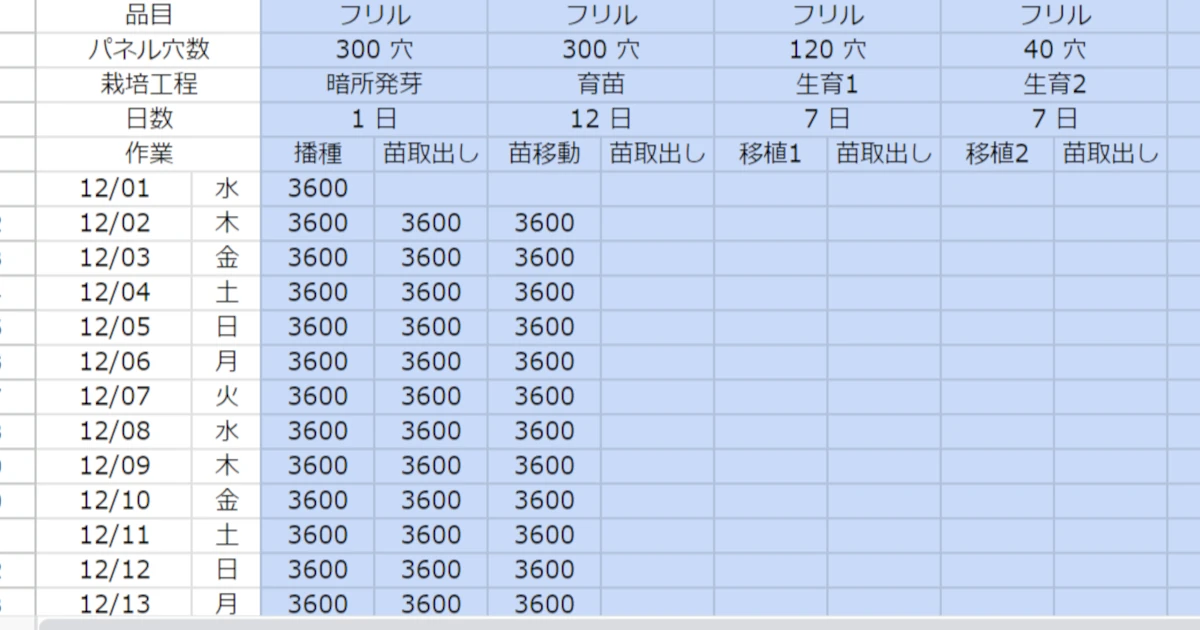
When building the schedule, you set the seeding date by working backward from the delivery date, spreading the workload evenly and assigning staff with their specialties in mind.
4-2. Optimizing the balance between labor efficiency and quality
Labor cost is a major cost in a vertical farm, and improving labor productivity is the key to higher revenue.
Staffing allocation example:
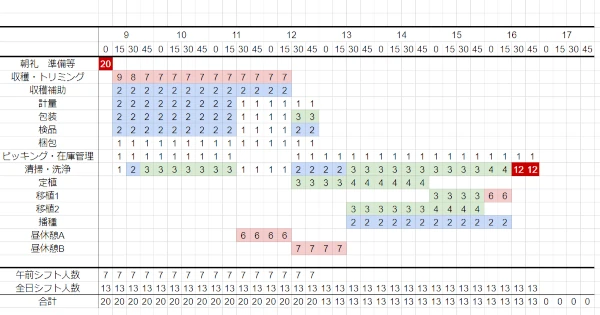
Practical steps to raise labor productivity:
- Analyze the current state: measure standard times by task
- Identify bottlenecks: pull out the processes that take the most time
- Draft improvements: brainstorm together with the staff
- Pilot it: verify on a small scale (about a week)
- Measure the effect: compare times before and after
- Roll it out: standardize the successful cases and put them into a manual
Clarifying quality checkpoints (writing out the quality items to check at each process), putting in a first-line check by the operator, and doing periodic sample inspections — these keep efficiency gains from turning into quality drops.
Point: Efficiency is not “faster” but “with less waste.” Simply speeding up the work risks fatigue and a higher defect rate.
Using a handy template
The calculations for crop schedules and process design we have covered so far take effort at first, but a purpose-built template lets you streamline the work dramatically.
Point: Starting the calculations and management for a crop schedule and process design from zero is tough. On this site we provide a range of templates that help with crop scheduling and process management. The necessary formulas and formats are already built in, so you can build a crop schedule simply by entering numbers.
Download the crop schedule template here. Please use it to streamline your work.
Wrap-up
A crop schedule functions as the reference point for decisions across the whole farm. By designing the three axes — what, to which specification, and how much — from both the market-needs side and the production-capacity side, you can suppress waste and lost opportunity at the same time.
On the process-design side, plant spacing and the splitting of growth stages — both driven by the capacity calculation — are directly linked to equipment utilization, and leveling the work is linked to stable labor cost. Stacking the numbers up carefully brings to the surface the bottlenecks that are hard to see when you run by feel.
A plan is not finished the moment you build it — it is something you keep updating as you reconcile it against actual data. The habit of feeding the small drifts on the floor back into the plan is what raises the precision of your production system over time.