Farm Operations Management
NFT vs. DFT in Hydroponics: How the Systems Differ and How to Choose
Articles for Farm Operations Managers
Choosing a hydroponic method is not just about picking the shape of the equipment. It is an operational design that covers daily management frequency, power-outage risk, water-temperature stability, and the oxygen environment around the roots.
The recirculating hydroponic systems commonly used in vertical farms are NFT and DFT. NFT is superior at supplying oxygen to the roots, but because it holds little water, management is demanding. DFT is highly stable, but it calls for a different kind of water-quality management.
This article lays out the fundamentals of hydroponics, the differences between NFT and DFT, daily inspections, and how to read trouble when it happens.
Hydroponics: Growing Without Soil
Hydroponics is a cultivation method that does not use soil. Instead of absorbing nutrients from soil, crops take them up from fertilizer dissolved in water. In Japanese, the terms 養液栽培 (“nutrient-solution cultivation”) and 水耕栽培 (literally “water culture”) are used in almost the same sense; this article uses “hydroponics” throughout.
Hydroponics is widely adopted in vertical farms and other protected cultivation for several operational reasons. You can precisely control the composition and concentration of fertilizer, pH, water temperature, and more, which makes it easier to shorten the growing cycle and raise yield. Because soil management (tillage, fertilization, soil improvement) is no longer needed, labor hours drop sharply, and depending on the system design, final planting and harvest can be done in an ergonomically favorable posture. The environment stays relatively free of pathogens and pests, so pesticide use is easier to keep down, and production becomes possible inside urban buildings, on rooftops, on barren land, and in other places where conventional cultivation was difficult. Multi-tier stacking also raises productivity per unit of floor space. The one caveat is that the initial equipment cost has to be factored in.
The Main Hydroponic Systems: NFT vs. DFT
Hydroponics includes several methods: solid-substrate culture (such as rockwool), drip irrigation, aeroponics, and liquid (water-based) culture. In this article, I compare two representative recirculating liquid-culture systems: “NFT” (Nutrient Film Technique) and “DFT” (Deep Flow Technique). In vertical farms, recirculating liquid-culture systems — NFT and DFT chief among them — are by far the most widely used.
Side-by-Side Comparison of NFT and DFT
First, let’s look at the main differences between the two systems in a table:
| Comparison item | NFT (Nutrient Film Technique) | DFT (Deep Flow Technique) |
|---|---|---|
| Water depth | Thin film of about 3 to 5 mm | Deep layer of about 5 to 15 cm |
| Basic structure | Sloped trough-shaped channels | Flat tank-shaped structure |
| Root condition | Only the lower part touches water; the upper part is in the air | Almost entirely submerged in water |
| Oxygen supply capacity | Very high (plenty of air contact) | Moderate (depends on dissolved oxygen in water) |
| Power-outage risk | High (plant damage within a few hours) | Low (roughly a day of buffer) |
| Temperature stability | Low (large swings due to small water volume) | High (small swings due to large water volume) |
| Pipe-clogging risk | High (narrow channels) | Low (wide channels) |
| Initial installation difficulty | Somewhat high (slope adjustment needed) | Low (can be installed level) |
| Suitable operating environment | Environment where constant management is possible | Environment with low management frequency, such as people farming only on weekends as a hobby or side business |
| Maintenance frequency | High | Moderate |
NFT makes it easier to optimize plant growth, but it demands attentive, hands-on management. DFT stands out for stability and a lighter management workload. If you can manage the system around the clock and want the best results, go with NFT; if you prioritize stability, go with DFT.
Oxygen Supply and the Root Environment
In NFT, most of the root mass is exposed to the air, so oxygen supply is abundant. Because the roots can draw in all the oxygen they need, they tend to develop white and healthy, spreading laterally with plentiful root hairs. In DFT, the roots are almost entirely submerged, so they depend on dissolved oxygen (DO), and they tend to extend vertically along the water flow.
Power Outage and Equipment Failure Risk
The biggest difference between the two systems is how much plant damage you can contain when a power outage or pump failure hits.
Because NFT holds little water, the plants start taking damage within a few hours of a power cut or pump failure. The risk is especially high in summer, and backup power is essential. DFT holds a large volume of water, so for an outage of anywhere from several hours up to about a day, damage can be kept to a minimum. The trade-off is that the water volume needed for operation is larger.
Temperature Stability
Because NFT holds little water, it is directly affected by outside air temperature and shows large swings. You have to deal with rising water temperatures in summer and keep the water warm enough in winter. DFT holds a large water volume, so its thermal mass is high and temperature changes come on gradually. Unless weather conditions are extreme, it can often be run without additional temperature-control equipment.
Maintainability
Because NFT has narrow channels, clogging by roots and algae happens easily, and regular pipe cleaning and inspection are essential. DFT has wide channels, so water flow is maintained even with some root growth, but compared with NFT, algae tend to develop more readily on the exposed water surface.
Daily Management and Troubleshooting for Hydroponic Systems
To run a hydroponic system stably, daily management and the right response when trouble occurs are both indispensable.
What to Check Every Day
On-site managers make a daily habit of checking water volume and water level, monitoring water temperature, observing root condition, and confirming that the system is running. Each check takes only a few minutes, but stacking them up day after day is what leads to early detection of anomalies.
Problems and Responses by System
Run any system long enough and trouble will show up in both NFT and DFT. I have summarized the problems that tend to occur in each and how to respond, side by side.
| Type of problem | NFT | DFT |
|---|---|---|
| Flow trouble | Problem: Wilting at the end of the line, uneven flow, inconsistent growth / Response: Pipe cleaning, filter cleaning, slope readjustment, review of pump capacity | Problem: Poor growth in parts of the area, stagnant water / Response: Strengthen the circulation pump, adjust flow direction, install additional aeration |
| Water-temperature problems | Problem: Sudden temperature rise (especially in summer), daytime plant wilting / Response: Cover the grow beds with insulation, increase circulating water volume, shade the piping | Problem: Gradual temperature change, long-term poor growth / Response: Insulate the entire tank, install an in-water heater, introduce a cooling system for a large volume of water |
| Power-outage risk | Problem: Catastrophic damage to plants within a few hours / Response: Backup power is essential, prepare for manual watering, alarm systems | Problem: With DFT, plants hold up for about 12 to 24 hours, but longer outages still cause damage / Response: Manual aeration only during long outages, water-temperature management |
| Clogging and stagnation | Problem: Clogging of the trough sections, root binding, stagnant flow / Response: Regular flushing, preventing excessive root extension, cleanable design | Problem: Stagnation in the root zone, localized shortage of dissolved oxygen / Response: Adjust flow direction, optimize aeration positions, stir the water regularly |
| Maintenance frequency | Problem: Frequent maintenance required, heavy workload / Response: Inspection once or twice a week, planned cleaning schedule | Problem: Algae growth, long-term nutrient imbalance / Response: Inspection once every 2 to 4 weeks is enough, long-term water-quality management plan |
| Seasonal response | Problem: Heavily affected by seasonal variation / Response: Set intensive management periods in summer and winter, strengthen environmental control equipment | Problem: Problems arise only under extreme weather conditions / Response: DFT systems run stably under normal weather conditions, and special measures are taken only during extreme weather |
How to Read Root Abnormalities
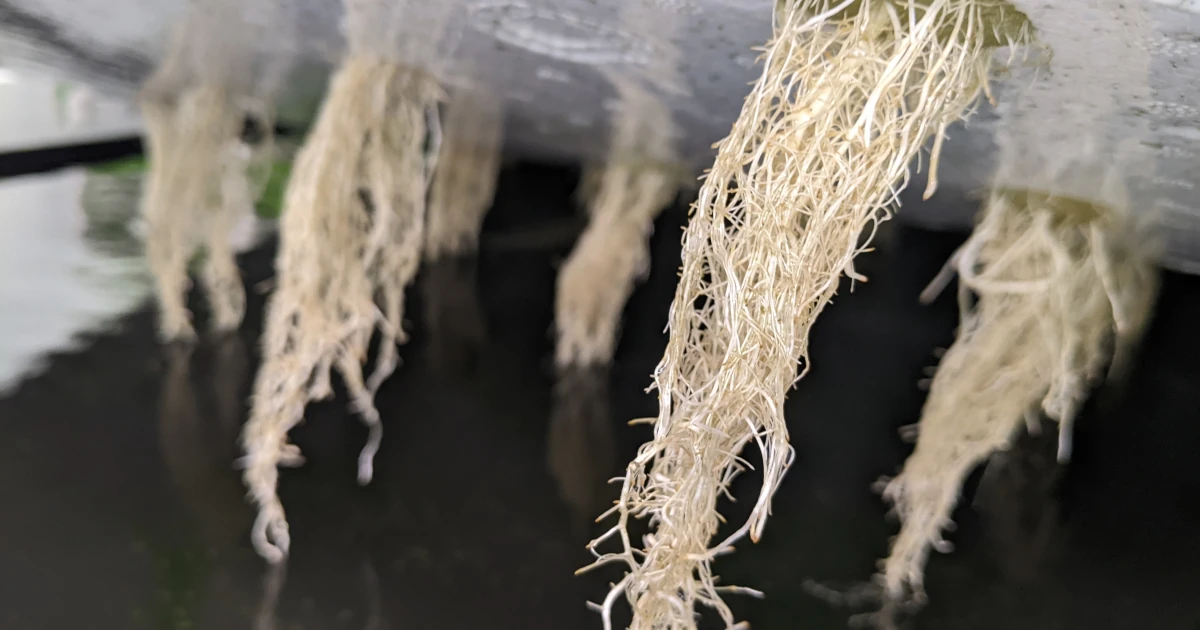
In hydroponics, the condition of the roots decides growth. Every one of the symptoms below calls for early detection, and making regular observation a habit is what keeps you from missing the window to respond.
- Browning of the roots (brown to black)
- Cause: Oxygen shortage
- Response: Strengthen aeration
- Slime or mucus-like coating
- Cause: Bacterial infection, water-quality deterioration
- Response: Full replacement of the nutrient solution, system disinfection; remove the diseased parts and transplant only the healthy plants and roots into a separate cultivation environment
- Root extension stops / Few root hairs
- Cause: Unsuitable water temperature, nutrient imbalance
- Response: Adjust water temperature (to 18 to 23 °C), review EC and pH values
- Roots turning reddish-brown
- Cause: Phosphorus deficiency, residual chlorine
- Response: Add phosphorus-containing fertilizer, avoid ammonia-based fertilizer
- Parts of the roots appear to melt away
- Cause: Infection by pathogens such as Pythium spp.
- Response: Sterilize the nutrient solution by methods such as UV irradiation or ozone treatment, and replace the solution
Summary
NFT and DFT are both proven systems, but their operational requirements are fundamentally different. The precise management NFT demands only pays off when you have round-the-clock response capacity and the expertise to go with it. DFT’s stability, by contrast, is a strength that keeps production steady even in environments with limited management resources.
Do not pick a method on initial equipment cost alone. You have to evaluate the on-site operating conditions together: your response plan for power outages, your ability to manage temperature in summer and winter, and the personnel you can devote to daily inspections. Power-outage risk in particular is NFT’s weak point, and a design that includes backup power is a prerequisite.
Daily monitoring — watching root condition, above all — leads directly to early detection of trouble, whichever system you choose. Understanding the character of the system and then building an operational design that fits your own cultivation environment is what leads to stable yield.
For more specialized knowledge and efficient operating methods, please also see “172 Tips for Raising the Profitability of a Vertical Farm” on this site.