Farm Operations Management
Humidity Management in Vertical Farms: Designing Control from VPD and Transpiration
Articles for Farm Operations Managers
Temperature and light are controlled in fine detail, but humidity is watched only as an average value. In a vertical farm, that is exactly where quality inconsistencies, disease, and condensation problems tend to hide.
Humidity is not a standalone environmental parameter. It drives several things at once: transpiration, calcium transport, stomatal opening and closing, condensation on equipment, and stagnant air.
In this article, I walk through how humidity affects yield and quality, the humidity troubles that tend to come up in vertical farms, sensor placement and how to read VPD, and dehumidification, air circulation, and condensation countermeasures — in the order you actually deal with them on the floor.
Humidity Management — The Overlooked Key to Profitability
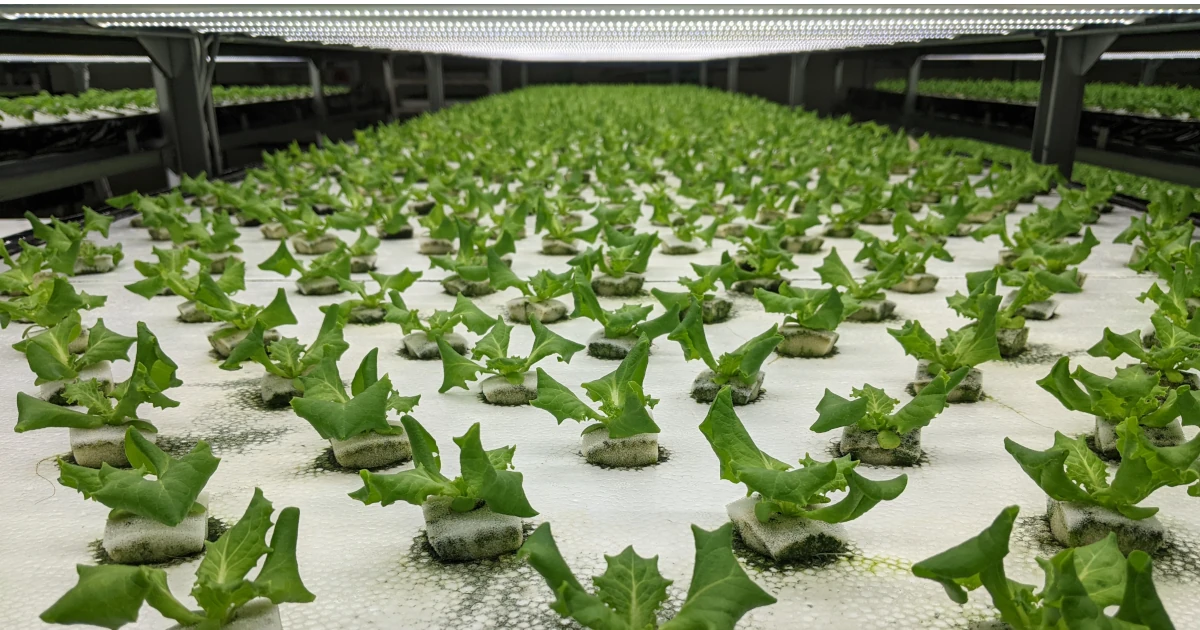
In vertical farms, attention tends to go to temperature, light, and many other environmental factors, but the one that has the biggest effect on profitability is humidity. It deserves the same systematic approach as temperature, and yet it gets pushed to the back — and people often notice the problem only after it has become serious.
What makes humidity unusual is that it is a compound factor — it affects a wide range of other conditions such as temperature, disease, and growth speed — yet the problems are hard to spot while they are happening. Proper management also produces a big effect from a relatively small investment, so it is a high-return area for improvement.
A 20% Yield Increase: The Link Between Proper Humidity and Growth Speed
Under the right humidity, plants carry out transpiration smoothly. The stomata on the leaves open and close properly, photosynthesis becomes more efficient, the uptake and translocation of nutrients such as calcium is promoted, and cell elongation proceeds smoothly. In facilities that optimize humidity, yield sometimes rises by around 20%. At a facility with annual revenue of JPY 10 million, that puts a revenue increase of around JPY 2 million within reach from humidity management alone.
Halving Quality Complaints: How Humidity Affects Appearance and Taste
Under high humidity, transpiration is suppressed and tipburn (dieback of the leaf tips) from calcium deficiency becomes more likely, which damages product value. On the other hand, vegetables grown under the right humidity have a better cellular water balance and look fresher. Poor humidity management raises disease risk and lowers product value, so it is also directly tied to reducing returns and discounts.
Extending Equipment Life: The Hidden Costs of Condensation
Excess humidity causes condensation on electrical distribution panels and control equipment, and this leads to short circuits and breakdowns. Continuous condensation accelerates corrosion on metal parts and shortens the life of the facility, and insulation that has soaked up moisture loses its thermal performance and drags down energy efficiency. The effect on equipment — alongside the effect on plants — is a major cost factor when humidity management is neglected.
Ask the Plants What the Ideal Humidity Is
Plants tell you through their appearance and growth patterns whether the environment is right. They are especially sensitive to humidity, so getting into the habit of reading their symptoms raises the accuracy of your judgment.
The Mechanism of Transpiration: A Plant’s Hidden Life Activity
For plants, transpiration is not simply the release of water — it is a physiological activity essential to survival. When water evaporates from the surface of a leaf, heat is taken away (heat of vaporization), which keeps the leaf temperature about 5 °C cooler than the surrounding air. In hot environments, transpiration cooling is what keeps photosynthesis going. But when humidity is too high, evaporation is suppressed and plants overheat. That is why the combination of high temperature and high humidity is dangerous.
Transpiration Keeps the “Water Highway” That Carries Nutrients Flowing
Transpiration is also the driving force of a plant’s internal circulation system. Water absorbed by the roots transpires from the leaves, and this creates a “root-to-leaf flow” that carries essential nutrients such as calcium through the plant body. When humidity exceeds 90%, this water flow slows down and symptoms of nutrient deficiency start to appear.
The Relationship Between Transpiration and Stomata, Which Governs Photosynthesis
Plants take in carbon dioxide through the stomata on the underside of the leaves, but when the stomata open, water escapes along with the CO2 they let in. When humidity is too low, plants close their stomata to prevent water loss, CO2 intake is blocked, and photosynthesis efficiency drops. For many plants, a relative humidity of 60 to 75% is the best balance between stomatal activity and water retention.
In vertical farms that use recirculating hydroponic systems, you do not need to worry much about humidity dropping. Transpiration keeps pushing humidity up, so active dehumidification is the default. “Humidity too low” — the kind that makes stomata close — means humidity down in the 40% range.
Warning Signs of Humidity Stress
You can read humidity stress from the symptoms plants show on their bodies.
SOS Signals of High Humidity: Tipburn, Disease, and Pests
Under high humidity, you need to watch out for two things. First, tipburn: high humidity suppresses transpiration so calcium is not delivered to the leaf tips, and it tends to show up especially on fast-growing young leaves. Second, disease outbreaks: when leaf surfaces stay wet for long periods, they become a hotbed for gray mold, sclerotinia rot, and similar diseases — early on, you see small lesions or white mycelia on the underside of the leaves.
The most obvious sign of high humidity is the formation of water droplets. If you see droplets on the tips or edges of leaves in the morning, you need to review your nighttime humidity management.
Danger Signs of Low Humidity: Leaf Wilt, Poor Growth, and Nutrient Disorders
When humidity is too low, water loss through transpiration is so intense that water uptake from the roots cannot keep up, and leaves can wilt or curl — especially during the day — and then recover in the evening. Excessive transpiration under low humidity also causes browning on leaf edges and tips, and closing stomata reduces photosynthesis, which leads to shortened internodes and delayed expansion of new leaves — growth stalls.
Humidity Troubles Specific to Vertical Farms
Because vertical farms are closed environments, they have humidity problems of their own that you do not see in conventional cultivation.
The Humidity Trap Plants Create Themselves: The Vicious Cycle of Transpiration and Sealed Space
The biggest feature of a vertical farm is that it is a closed environment. Fully grown plants transpire large amounts of water (over 100 mL per head of lettuce per day), and this water stays trapped inside the sealed space and drives humidity up sharply. The cycle — humidity rises, transpiration is suppressed, growth stalls — is the fundamental risk of closed-environment facilities.
Three Factors That Create Humidity Unevenness
Inside a vertical farm, even environments that look uniform have significant humidity differences depending on location. Because warm air rises and cold air falls, the area near the ceiling tends to be hot and dry, while the floor tends to be cool and humid (vertical humidity gradient). Places where air conditioner or fan airflow hits directly dry out sharply, and on the same cultivation rack you get a mix of too dry and too wet (local drying caused by airflow). Humidity also rises around walls and equipment surfaces where the air is cooled, and during strong summer cooling in particular, condensation forms around the cold air outlets (humidity rise around walls and equipment). At facilities with only one sensor installed, this kind of humidity unevenness often goes unnoticed, and it leads to unexplained quality inconsistencies and disease outbreaks.
The Downside of High-Density Cultivation: Restricted Airflow
In densely planted conditions, leaves overlap and airflow is blocked, and a “micro-humidity environment” forms around the plant body where humidity is extremely high. This is a perfect breeding ground for pathogens. Sensors are usually installed in aisles and open space, so actual humidity in the densely planted area is significantly higher than the measured value — even when the humidity gauge reads 70%, humidity at the leaf surface can easily be above 90%. Securing proper plant spacing reduces disease risk and leads to higher revenue over the long term.
How to Identify Condensation Points Caused by Temperature Differences
The temperature at which water vapor in the air begins to form droplets is the dew point temperature. In an environment at 70% relative humidity and 25 °C, the dew point is about 19 °C, so any surface at 19 °C or below will have condensation on it. Metal parts on the structure, piping, and electrical equipment chill quickly and condense readily, and areas near exterior walls or places with weak insulation also need attention. Once you find the condensation points, adding insulation and improving airflow solve most of them.
Spotting Humidity Anomalies with Data
To catch humidity anomalies early, you need accurate data collection and analysis.
Effective Methods for Collecting Humidity Data
In humidity management for a vertical farm, what matters most is the “quality” and “placement” of the data. Install sensors at different heights in the cultivation area — upper, middle, lower — and also in places where the environment changes dramatically, such as near walls or fans. Installing them close to the plant leaves lets you measure the actual growing environment. A 10-minute sampling interval is the baseline, and more frequent measurement is effective at light switching times and when HVAC equipment kicks on. You need to track not only daily variations but also weekly and monthly trends.
More sensors are not always better. It is more efficient to narrow down to the measurement points that can represent the humidity trends of the cultivation area as a whole.
[Free] 13 Templates for Farm Operations Management in a Vertical Farm
Do Not Miss Local Humidity Spikes
When you analyze data logs in detail, you can find short-term humidity spikes. These short spikes are often signs of HVAC shutdowns caused by control software bugs, or of water leaks and plumbing trouble. They get buried in averages, so checking the max and min values is critical.
Overall Judgment That Does Not Rely on Relative Humidity Alone
The Key Indicator: Vapor Pressure Deficit (VPD)
What professional growers pay attention to is vapor pressure deficit (VPD). VPD is the amount of additional water vapor the air can hold before it becomes saturated, and the unit is usually g/m³. It is a direct measure of how easily plants can transpire, and unlike relative humidity, it evaluates the effect on plants consistently even when temperature changes.
At 70% relative humidity, the VPD is 5.1 g/m³ at 20 °C and 9.0 g/m³ at 30 °C — a big difference. Even at the same relative humidity, higher temperature means a larger VPD and more water stress on the plants. You need to make the call with temperature in view as well.
The Essence of Humidity Control
Key Points for Choosing Equipment
Choosing a Dehumidifier Without Failing
- Choose capacity based on the plants’ transpiration volume
- For 1,000 lettuce heads, you need a capacity to process at least 50 L per day
- Daily required dehumidification (L) = number of plants × 0.05 L
- Three specs to check
- Continuous drainage (tank-type units are not suitable for commercial use)
- Energy efficiency (choose a high COP (coefficient of performance))
- Noise level (consider the impact on the working environment)
Tip: When picking a dehumidifier, choose “capacity with headroom against the water the plants put out.” A unit that is too cheap ends up costing more over the long term.
How to Use Circulation Fans Effectively
- The golden rules of placement
- Install multiple units at different heights (upper, middle, lower)
- Keep them at least 1 m from the walls
- Adjust the angle so the airflow does not hit the plant leaves directly
- Wind speed guideline
- 0.3 to 0.5 m/s at canopy level
- Simple measurement method: hang a tissue and look for it to sway gently
Tip: When humidity rises suddenly, an ordinary fan can stand in. It is effective to aim it down the aisles between plants.
Daily Humidity Management in Practice
What to Check on the Floor
- Three signs to check every morning
- Are there water droplets on the leaf surfaces? (evidence of high humidity)
- Are the leaf edges curling? (evidence of low humidity)
- Is there condensation on metal parts?
- Routine inspection items
- Cleaning the dehumidifier filter (clogging reduces capacity)
- Checking the drain hose for blockage (a cause of leaks)
- Checking the insulation condition at places prone to condensation
What to Do When Humidity Exceeds 90%
- First, set the circulation fans to maximum to stir the air
- If possible, lower the target humidity on the dehumidifier
- If possible, switch the air conditioner to dry mode for dehumidification. If you are using heating-based dehumidification, also run a separate cooling system to prevent the room temperature from rising
Emergency Measures When Equipment Breaks Down
- When the dehumidifier fails
- Lower the air conditioner set point by 2 °C to boost dehumidification
- Run the circulation fans at maximum to push airflow
- If there is no backup unit, a household dehumidifier is still useful as an emergency measure
Tip: Prepare a checklist on a tablet or paper, and build the habit of walking the same route at the same time every day. It cuts down on things you miss.
Concrete Measures for Zero Condensation
Common Condensation Points and Countermeasures
| Condensation point | Cause | Countermeasure |
|---|---|---|
| Metal frames near walls | Temperature difference with outside air | Wrap with insulation tape |
| Around AC air outlets | Local cooling from cold air | Adjust wind direction and install an airflow cover |
| Behind electrical distribution panels | Moisture stagnating in enclosed space | Install a small fan and place a desiccant |
| Piping near the floor | Cooling from cold water passing through | Wrap with insulation and raise it off the floor |
- Easy condensation countermeasures
- Even insulation sheets sold at 100-yen shops (Japan’s equivalent of dollar stores) work for emergency measures
- Install a small fan at the condensation point to create airflow
- Protect electrical equipment with waterproof tape or covers
How to find condensation: Walk through the facility in the early morning (the coldest time of day). Bring a hand mirror close to places that look cold, and see if the mirror surface fogs up. That tells you where the condensation-risk points are.
Summary
What makes humidity management hard is that plants and equipment are already damaged before the problem shows up as a number. Unlike temperature and light, the effects of humidity are indirect and delayed. By the time tipburn or disease surfaces, the humidity disturbance that caused it often happened days earlier.
From the data-usage standpoint, chasing the average of relative humidity alone is not enough. Evaluate the combined effect with temperature using VPD, catch spikes with max and min values, and grasp spatial unevenness with multiple sensors. Humidity management works only when these three are in place.
As for investment priorities, a dehumidifier with the right capacity and securing air circulation are the basics. Condensation countermeasures tend to get pushed back, but breakdowns and corrosion of electrical equipment are expensive to repair, so it is an area where early action pays off the most.
Because changes in humidity management are hard to see, daily recording and observation are what your judgment rests on. Verifying with numbers and checking against the state of the plants — that habit is what leads to long-term revenue stability.