Farm Operations Management
How to Make a Nutrient Solution with Straight Fertilizers: Blending, Preventing Precipitation, and Concentration Calculations in Practice
Articles for Farm Operations Managers
Pre-mixed fertilizers are convenient. But the more you push for tighter precision and lower cost in hydroponics, the harder it becomes to avoid straight fertilizers.
The essence of straight fertilizer management is not about splitting fertilizers into ever smaller pieces. It is about being able to deliver the nutrients you need, in the amounts you need, in response to the crop’s condition, nutrient solution analysis, and the character of your source water.
This article walks through the basics of straight fertilizers, the reason for separating them into Part A and Part B, solution design using mEq/L, how to prepare stock solutions, and practical tips for reducing precipitation and weighing errors.
Start with the basics of straight fertilizers
The fertilizers used in hydroponics fall broadly into two categories: “straight fertilizers” and “pre-mixed fertilizers.”
Straight fertilizers are fertilizers built around a single main component, such as calcium nitrate or magnesium sulfate. Calcium nitrate supplies calcium and nitrogen; magnesium sulfate supplies magnesium and sulfur. Each is specialized for a specific nutrient.
Pre-mixed fertilizers, on the other hand, are fertilizers in which multiple components are pre-blended in fixed ratios. Typical liquid fertilizers, and the fertilizers included in hobby hydroponics kits, are pre-mixed fertilizers. Micronutrient mixes that contain every trace element are also a type of pre-mixed fertilizer.
Pros and cons of straight fertilizers
The greatest advantage of straight fertilizers is the freedom to adjust each component. Because you can change the concentration of each nutrient individually according to the crop’s condition and growth stage, you can raise potassium during fruit sizing, raise nitrogen during leaf growth, and so on. If a nutrient solution analysis shows that just one component is deficient, you can top up that component alone. Over the long term, because you use only the nutrients you need in the amounts you need, raw material cost comes out lower than with pre-mixed fertilizers. At larger scales, this difference accumulates into substantial savings.
On the other hand, straight fertilizers require a certain amount of effort and knowledge. You need specialist knowledge about each fertilizer’s characteristics and how they combine, and concentration calculations and accurate weighing take practice. Since you manage and store multiple fertilizers individually, inventory management also becomes more complex, and the risk of weighing errors is higher than with pre-mixed fertilizers. That said, turning the work into a checklist keeps mistakes well in check.
A practical approach
A realistic balance between cost and management effort is to manage the major components with straight fertilizers and cover the micronutrients with a pre-mixed fertilizer (a micronutrient mix). Using straight fertilizers for the major components alone lets you capture the cost benefit while keeping management complexity reasonable.
If you are just starting out with hydroponics, the realistic path is to begin with the main straight fertilizers (calcium nitrate, potassium nitrate, monopotassium phosphate, and so on) and gradually expand the range.
Why you separate into Part A and Part B
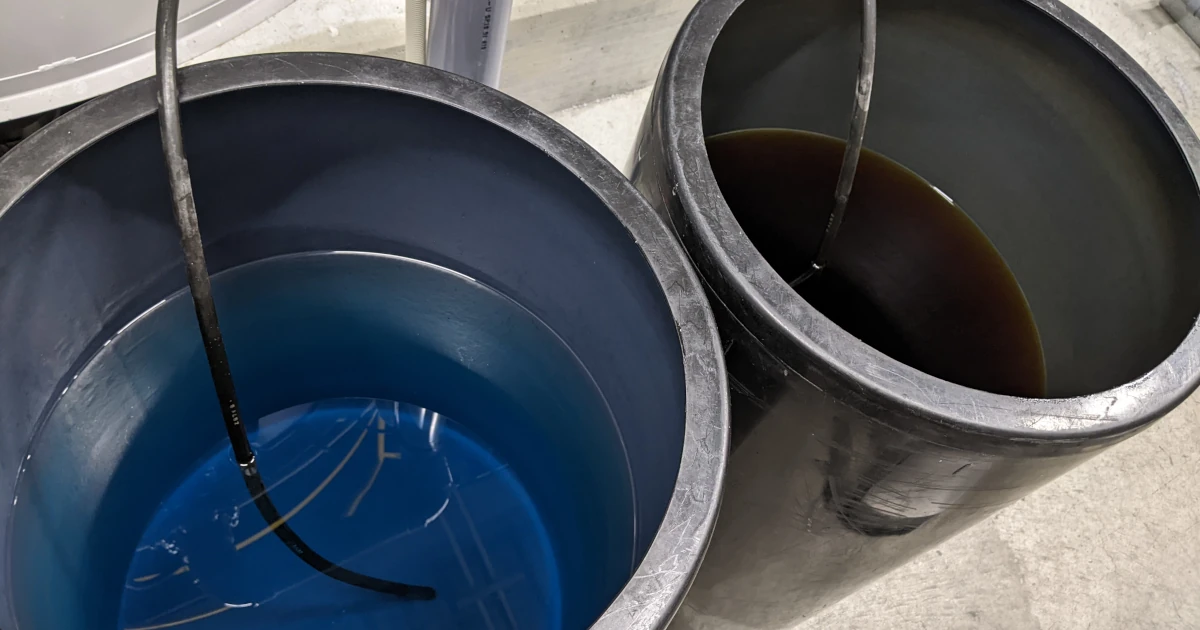
In hydroponics, the reason fertilizers are separated into “Part A” and “Part B” is to prevent precipitation caused by chemical interactions between components. This separation is not just a convention; it is an important technique for keeping fertilizer components stable.
When calcium ions (Ca²⁺) are mixed at high concentration with phosphate ions (H₂PO₄⁻, HPO₄²⁻) or sulfate ions (SO₄²⁻), they form insoluble salts (calcium phosphate or calcium sulfate). Once these precipitates form, the crop can no longer use those nutrients, clogs develop inside the hydroponic system, and accurate control of nutrient concentrations becomes difficult.
In stock solutions in particular, calcium, phosphate, and sulfate ions are present at concentrations dozens of times higher than in the working solution. As a result, once these ions meet, large amounts of precipitate form instantly. For example, if you mix calcium nitrate and monopotassium phosphate at stock-solution concentration, a white precipitate (calcium phosphate) appears within seconds.
Many of you have probably done it: while dissolving fertilizers, you accidentally drop a Part A fertilizer into the Part B tank, and the whole batch is ruined.
Other factors affecting stock solution stability
Several other factors influence the stability of a nutrient solution. The lower the pH, the easier it is for fertilizer components to stay in solution. At low temperatures, fertilizer solubility drops and crystals tend to precipitate out. And when the stock solution is too concentrated, it exceeds its solubility limit and crystallizes out.
When the nutrient solution turns alkaline, the solution temperature is low, and the EC is high, precipitation risk rises further. If you see fine white or brown particles floating in the nutrient solution, precipitation may already be happening.
Types of straight fertilizers and how they split between Part A and Part B
| Straight fertilizers for Part A | Straight fertilizers for Part B |
|---|---|
| Monopotassium phosphate (KH₂PO₄) | Calcium nitrate (Ca(NO₃)₂) |
| Monoammonium phosphate (NH₄H₂PO₄) | |
| Magnesium sulfate (MgSO₄·7H₂O) | |
| Potassium sulfate (K₂SO₄) | |
| All micronutrients |
Fertilizers that can go in either side:
- Potassium nitrate (KNO₃): can be distributed between Part A and Part B depending on the nutrient balance
- Ammonium nitrate (NH₄NO₃): used for fine-tuning nitrogen concentration
Designing a nutrient solution with straight fertilizers
Nutrient solution design is the process of deciding “which fertilizer” to use and “how much” of it, matched to the crop’s requirements. Below, I go through the basic calculation method and how to find the optimal concentration.
Macronutrient concentration calculations (mEq/L)
In hydroponics, nutrient concentrations are managed in “mEq/L (milliequivalents per liter).” This is not simple weight concentration (ppm); it expresses the electrical activity of the ion. Since plants absorb nutrients in ionic form, mEq/L gives you a more scientifically grounded way to manage nutrients.
Me/L indicates not so much “how much is there” but “how much is available to participate in chemical reactions.” For example, potassium (K⁺) and calcium (Ca²⁺) have very different chemical activity even at the same weight. This is because potassium exists as a monovalent ion (K⁺) and calcium as a divalent ion (Ca²⁺).
Concretely, 100 mg/L of K⁺ is about 2.6 mEq/L (2.6 millimoles × valence 1), while 100 mg/L of Ca²⁺ is about 5.0 mEq/L (2.5 millimoles × valence 2). At almost the same weight and molar amount, calcium has roughly twice the chemical reactivity of potassium. Using mEq/L lets you accurately express this difference in reactivity caused by valence, and grasp the chemical capacity of the ions that the plant can actually use.
Let’s work through a concrete calculation
Let’s walk step by step through the calcium nitrate (Ca(NO₃)₂·4H₂O) calculation for the Yamazaki formulation — a standard nutrient-solution recipe developed by the Japanese agronomist Dr. Yamazaki and widely used for lettuce cultivation.
In the Yamazaki formulation, the calcium concentration is set at 2 mEq/L.
STEP
Calculate the molecular weight of calcium nitrate
The molecular weight of Ca(NO₃)₂·4H₂O can be calculated as follows:
- Calcium (Ca): 40.1
- Nitrogen (N): 14.0 × 2 = 28.0
- Oxygen (O) [in the nitrate portion]: 16.0 × 6 = 96.0
- Hydrogen (H) [in the water of crystallization]: 1.0 × 8 = 8.0
- Oxygen (O) [in the water of crystallization]: 16.0 × 4 = 64.0
Total: 40.1 + 28.0 + 96.0 + 8.0 + 64.0 = 236.1
STEP
Calculate the gram equivalent of calcium
The gram equivalent corresponds to the number of electrons that one mole of a substance can release or accept.
Gram equivalent of Ca = atomic weight of Ca ÷ valence of Ca = 40.1 ÷ 2 = 20.05
STEP
Calculate the required amount of calcium nitrate
The amount of calcium nitrate required to make 1,000 liters of nutrient solution is:
Required amount (g/1,000 L) = target concentration (mEq/L) × gram equivalent of calcium × molecular weight of calcium nitrate ÷ atomic weight of calcium
= 2 (mEq/L) × 20.05 × 236.1 ÷ 40.1
= 2 × 20.05 × 236.1 ÷ 40.1
= 236.1 (g/1,000 L)
So for the Yamazaki formulation, making 1,000 liters of nutrient solution requires 236.1 g of calcium nitrate.
You calculate the required amounts of the other fertilizer components (potassium nitrate, monopotassium phosphate, etc.) in the same way. However, because adding calcium nitrate already supplies nitrate (NO₃⁻) ions, when you calculate nitrate salts such as potassium nitrate, you need to account for the nitrate already added.
For example, if calcium nitrate supplies 4 mEq/L of nitrate and your target nitrate concentration is 10 mEq/L, then the nitrate to be supplied by potassium nitrate is 6 mEq/L (10 mEq/L – 4 mEq/L). Advancing the calculation while keeping the balance of each ion in view is the basic flow of nutrient solution design.
How to determine the optimal fertilizer concentration
Once you understand nutrient solution design, the next question is how to determine the concentration that is optimal for your crop. This is not just an initial setting for the recipe; the real core is the continuous adjustment you make during the crop cycle.
Analyze the components of the nutrient solution
Nutrient solution analysis is a way to accurately measure the concentration of each nutrient currently in the solution. Regular nutrient solution analysis tells you where each component is over or under, how much fertilizer the crop is taking up, and whether the recipe is still appropriate.
For example, if the analysis shows that potassium concentration has dropped significantly, it means the plants are actively absorbing potassium. In that case, set the potassium concentration slightly higher the next time you prepare the nutrient solution. The basic principle is simple: raise the concentration of components with high uptake (components whose analysis values are dropping), and lower the concentration of components with low uptake (components whose analysis values barely change).
Once the balance of components stabilizes, pH swings also settle down. I cover more advanced adjustment points further down.
Concrete procedure for adjusting the recipe
- Compare with the previous nutrient solution analysis results:
- Track the concentration change of each component over time and judge which components are being absorbed most and which are accumulating.
- Adjust fertilizer amounts:
- Typically, adjust the dosage of each fertilizer in increments of around 10 percent. Sudden changes stress the plants, so step-by-step adjustment is preferable.
- Check the overall balance:
- Check that the adjusted recipe still hits the target component balance (for example, the N:P:K ratio). Adjusting only one component can break the balance with the others.
Do not obsess over exact numbers; rough adjustment is fine. What matters is flexibly tuning the recipe while watching the analysis results and the condition of the plants. In practice, the attitude of observing the plants’ response and continuously improving works better than chasing a perfect recipe.
Use a nutrient solution design tool
I have just explained how to calculate mEq/L, but in real facilities almost no one does these complicated calculations by hand every time. The standard is to use a dedicated calculation tool or spreadsheet.
There are many kinds of nutrient program tools. Some are simple enough to build yourself, and ready-made tools are available online. Using one of these tools removes the tedious calculation work and makes nutrient solution design more accurate and efficient. Adjusting the balance of components by hand is complex, but with a calculation tool you can respond quickly.
On this site, I offer a free, simple tool that handles both straight and pre-mixed fertilizers in one calculation.
[Hydroponics] A super-simple, easy-to-use nutrient program tool: SimpleFert
How to make a nutrient solution with straight fertilizers (practical steps)
Here are the concrete steps for making a nutrient solution with straight fertilizers, broken down by step.
Step 1: Equipment and preparation
You need the following basic equipment.
- Electronic balance: for weighing fertilizers
- Measuring spoons and scoops: in various sizes
- Stirring rod: for mixing the nutrient solution
- Trays or boxes: for holding the fertilizers
- Tanks: containers to hold water
Step 2: Understand how to split into Part A and Part B
When preparing stock solutions for a nutrient solution, you separate the fertilizer components into Part A and Part B to prevent precipitation. The basic principle is as follows.
- Into Part A: phosphates, sulfates, potassium salts, magnesium salts, and micronutrients
- Into Part B: calcium salts
Potassium nitrate can be distributed between Part A and Part B as needed. Add the fertilizers one at a time, and wait until the previous fertilizer has almost fully dissolved before adding the next. To prevent weighing errors, it is also important to list out the amounts you need before you start.
Step 3: Procedure for preparing stock solutions
Step 3-1: Weighing the fertilizers
- Weigh out all required fertilizers
- Measure the amounts you calculated in advance accurately
- Divide the weighed fertilizers into portions and label them
- Weigh hygroscopic fertilizers (especially calcium nitrate) quickly
Step 3-2: Preparing the water
- Pour water into the container
- Fill to about half the final volume
- Water temperature of 15 to 25 °C is ideal (if it is too cold, find a way to warm it)
Step 3-3: Preparing Part A
- Dissolve the phosphate fertilizer first
- Add monopotassium phosphate (KH₂PO₄) to the water a little at a time
- Adding the phosphate first lowers the pH and makes the other components easier to dissolve
- Add magnesium sulfate
- Add magnesium sulfate (MgSO₄·7H₂O)
- Add the potassium fertilizer next
- Add potassium nitrate (KNO₃) and dissolve
- Add potassium sulfate (K₂SO₄) as needed
- Add the micronutrients last
- Adjust the volume
- Add water to reach the final target volume
- Stir thoroughly until everything is fully dissolved
Step 3-4: Preparing Part B
- Dissolve calcium nitrate
- Add calcium nitrate (Ca(NO₃)₂·4H₂O)
- Calcium nitrate releases heat as it dissolves, which makes subsequent fertilizers easier to dissolve.
- Add the remaining fertilizers
- Add potassium nitrate and others as needed
- Adjust the volume
- Add water to reach the final target volume
- Stir well
Step 3-5: Storage
- Store appropriately
- Keep out of direct sunlight
- Micronutrients in particular degrade under light, so take care
- Clearly label the containers as Part A and Part B
This stock solution is diluted roughly 100-fold at the time of use to serve as the nutrient solution. Always dilute Part A and Part B separately; do not mix them directly. Mixing them at stock-solution concentration will cause precipitation.
Practical tips for managing straight fertilizers
Technique for preventing iron precipitation
When pH exceeds 6.5, iron ions precipitate as iron hydroxide and are no longer absorbed by the plant. The problem is especially pronounced in hard water or in water with high bicarbonate concentrations.
Practice and tips
- Keep the overall nutrient solution pH in the range of 5.5 to 6.2
- The choice of chelating agent matters (Fe-EDTA: pH 4.0 to 6.5, Fe-DTPA: pH 4.0 to 7.5, Fe-EDDHA: pH 4.0 to 9.0). There are highly stable chelated iron products like Fe-EDDHA, but the more stable the product, the higher the price.
- Always put iron into Part A and stir it in immediately to prevent oxidation
Measures to prevent weighing errors
In straight fertilizer management, a weighing error can have a large impact on the crop. Once a fertilizer is dissolved, you often cannot spot the mistake by eye alone, so measures taken before the work starts matter a great deal.
Practice and tips
- For small amounts (1 to 10 g), use a precision electronic balance (0.1 g resolution); for medium or larger amounts, use a standard electronic balance
- Color-code the Part A and Part B containers (for example, Part A = blue, Part B = red) to separate them visually
- Prepare a weighing checklist and tick items off as you go
- Pre-mix micronutrients and store them in pre-measured portions to reduce the number of weighings
- Make it a habit to say each amount out loud to confirm it
Responding to weighing errors
- If the error is within 15 percent of the target amount: top up the missing component if it is short, or dilute if it is in excess
- If the error exceeds 15 percent of the target amount: discard the nutrient solution and prepare it again
Storage and shelf-life management for straight fertilizers
Some straight fertilizers change in quality depending on how they are stored. Storing them under appropriate conditions lets you get the most out of them. The basic rules are to keep the temperature at 10 to 25 °C and humidity on the lower side. Keep them out of direct sunlight, and store micronutrients in particular in light-blocking containers.
Fertilizer-specific notes: calcium nitrate is the most hygroscopic and must be kept sealed. Magnesium sulfate tends to clump, but it is fine if you crush it before use. Micronutrients, especially iron formulations, are prone to oxidation and should be kept in light-blocking containers.
Causes of precipitation and countermeasures
Precipitation is one of the main troubles in hydroponics. The causes and countermeasures differ by type.
Main types of precipitate and their characteristics
- Calcium phosphate: a fine white to grayish-white precipitate; tends to form at pH 6.0 and above
- Calcium sulfate: a white crystalline precipitate; tends to form under low-temperature, high-concentration conditions
- Iron precipitate: brown to reddish-brown; tends to form at pH 6.5 and above or in sunlit environments
- Calcium carbonate: a white powder; tends to form when hard water is used or at pH 7.0 and above
The basic countermeasures are to enforce proper Part A / Part B separation, to dilute before mixing, and to regularly measure and adjust pH in the range of 5.5 to 6.2.
Summary
The starting point for straight fertilizer management is understanding the component separation rule (Part A and Part B) and weighing accurately. If either of these breaks down, it shows up directly in the crop as precipitation or concentration drift. Put the other way around, if you have these two points under control, handling straight fertilizers is less difficult than it looks.
On calculation and design, you do not need to master mEq/L from the start. By repeatedly using an existing recipe like the Yamazaki formulation as a base and adjusting components little by little according to nutrient solution analysis results, a recipe suited to your own facility’s growing conditions will come into view. Steady adjustments in increments of about 10 percent, accumulated over time, lead to high-precision nutrient solution management.
The cost advantage of straight fertilizers becomes more pronounced as scale grows. Switching even just the main components to straight fertilizers should significantly reduce raw materials cost compared with sticking to pre-mixed fertilizers. Starting with a hybrid approach, where micronutrients come from a mix, lets you capture the cost benefit while keeping management complexity in check.