Farm Operations Management
Harvesting in a Vertical Farm: From Fundamentals to Efficiency and Quality
Articles for Farm Operations Managers
Harvest is the final step of vertical farm production, and it is also one that has a large impact on profit. The timing of harvest, the precision of trimming, and the flow through to packaging determine both quality and marketable yield at the same time.
In hydroponics in particular, crops grow quickly and the daily workload piles up fast. A difference of just a few seconds per head shows up, at daily production scale, as a gap in labor and manufacturing cost.
In this article, I lay out the basics of harvest work, the handling that preserves quality, and approaches to process improvement and automation.
1. Why is the harvest step so important in a vertical farm?
A vertical farm is a system that reliably produces vegetables and other crops inside a closed environment by artificially controlling temperature, humidity, light, CO2 concentration, and other conditions. Among the cultivation methods used in a vertical farm, hydroponics—which uses water and nutrient solution instead of soil—is attracting interest because it is clean and has a low environmental impact.
Harvest plays a central role in this hydroponics system. The timing and method of harvest directly govern the freshness, nutritional value, and flavor of the vegetables, and judging the right harvest window and minimizing losses are what maximize yield. How smoothly the harvest step runs, in turn, affects both labor cost and productivity.
2. Harvest know-how specific to hydroponics
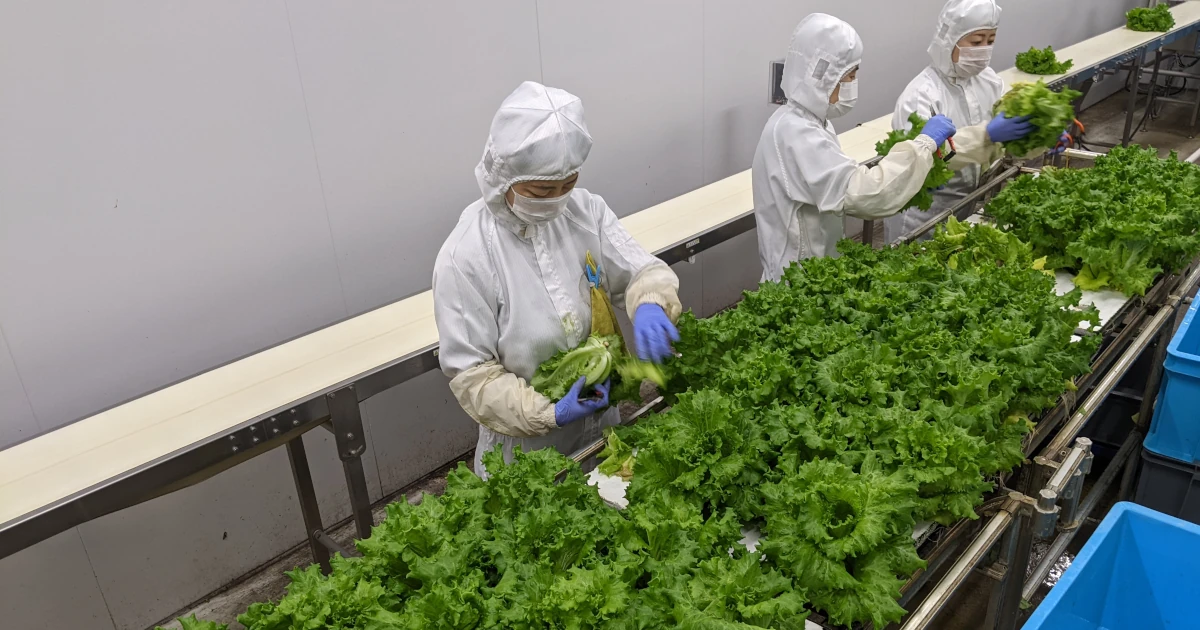
Harvesting in hydroponics differs from soil-based cultivation in many ways, and it calls for its own know-how.
2-1. Thorough hygiene management
Because hydroponics does not use soil, hygiene management of the water and nutrient solution is extremely important. Hand washing and disinfection before work are the absolute basics. Knives, scissors, harvest containers, and other tools should be cleaned and dried promptly after use, and waste and standing water in the harvest area should be cleared away frequently.
2-2. Judging the right harvest timing
Crops grown hydroponically develop faster than those in soil, so close observation and accurate judgment of harvest timing matter. Know the proper harvest window for each cultivar and check growth regularly. Using environmental data and growth data collected by sensors, you can raise the accuracy of harvest-timing prediction even further.
2-3. Post-harvest handling
Trimming, sorting, and packaging after harvest are the steps that determine quality retention and the efficiency of shipment preparation. Trimming demands precision—remove too much and yield drops. Between washing and packaging, it is also critical that neither the vegetables nor the packaging materials retain any surface moisture. Residual moisture leads to mold and spoilage, so thorough drying is a precondition. For sorting, set clear size and quality standards and grade accordingly.
Improving the harvest step is what decides a farm’s profitability
In the cost structure of a vertical farm, labor accounts for a large share.
And most of that labor cost comes from harvest and post-harvest work. In other words, whether the workflow is designed so that workers can carry out harvest and post-harvest tasks efficiently is what makes the manufacturing cost of the whole farm go up or down.
For example, at a farm producing 10,000 heads per day, shaving just one second per head off the combined harvest and post-harvest work cuts daily labor cost by about 3,000 yen.
Profitable vertical farms understand that efficiency in the harvest step translates directly into labor cost and manufacturing cost, and they apply their own know-how to continuously accelerate it.
We provide vertical farm managers with know-how for raising profitability.
If you want to improve your operations, please take a look at the content below.
172 Tips for Raising the Profitability of a Vertical Farm
3. Automation and efficiency
In recent years, automation and efficiency gains in the harvest step have been advancing at vertical farms. At present, no one has fully deployed the technologies described below across the entire harvest process, but they may well become the standard approach in the future.
“AI harvest robots”—robots equipped with AI that assess harvest readiness and harvest automatically—are under active development, alongside image-recognition technology that analyzes camera images to judge harvest timing and quality. On the data-analysis side, combining environmental data collected by sensors (temperature, humidity, CO2 concentration, and so on) with growth data makes it possible to predict the optimal harvest window and to forecast future yield.
Optimizing the production line is also a key priority. Analyzing worker motion paths to cut down walking distance is one efficiency improvement you can make without any capital investment. Introducing conveyors, robots, and other material-handling systems is a way to achieve efficiency gains and labor reduction at the same time, but the return on the initial investment must be weighed carefully.
Summary
The realistic way to improve the harvest step is along two axes: raising the precision of the fundamentals—hygiene management, timing, and post-harvest handling—and cutting cost through a rethink of the workflow design.
Adoption of automation technology is expected to expand further going forward, but as things stand, improving worker motion paths and reducing human error through standardization offer the best return on investment. For raising the profitability of a vertical farm, continuous improvement of the harvest step is indispensable.