Farm Operations Management
Using Data in a Vertical Farm: Improving Yield and Cost Through Records and Analysis
Articles for Farm Operations Managers
The strength of a vertical farm is that you can control the environment. But the ability to control is not enough on its own — yield and quality will not stabilize. Unless you record what you changed and what happened as a result, improvement stays at the level of personal anecdotes stacked on top of each other.
Temperature, humidity, light intensity, CO2 concentration, EC, pH, yield, defect rate. These numbers are not merely administrative records; they are the basis for decisions on the floor.
In this article, I lay out the data a vertical farm should record, and how to read it so that it leads to higher yield and lower cost.
Why Data Analysis Matters
In a closed environment like a vertical farm, even small shifts in conditions have a large impact on how the crop grows. A deviation that could be brushed off as weather-related noise in open-field farming is, in a fully controlled environment, something you can pin down as a reproducible cause and correct. For that reason, crop management that relies only on experience and intuition makes it hard to secure a stable yield.
In a vertical farm you can use a range of sensors to quantify environmental conditions and crop status. Analyzing this data lets you identify the factors that drive yield, clarify the optimal growing environment, and catch early signs of disease or poor growth. Data analysis enables more precise crop management, which in turn brings higher yield, better quality, lower cost — and, on top of that, a stable supply.
The Basics: What Data Should You Record?
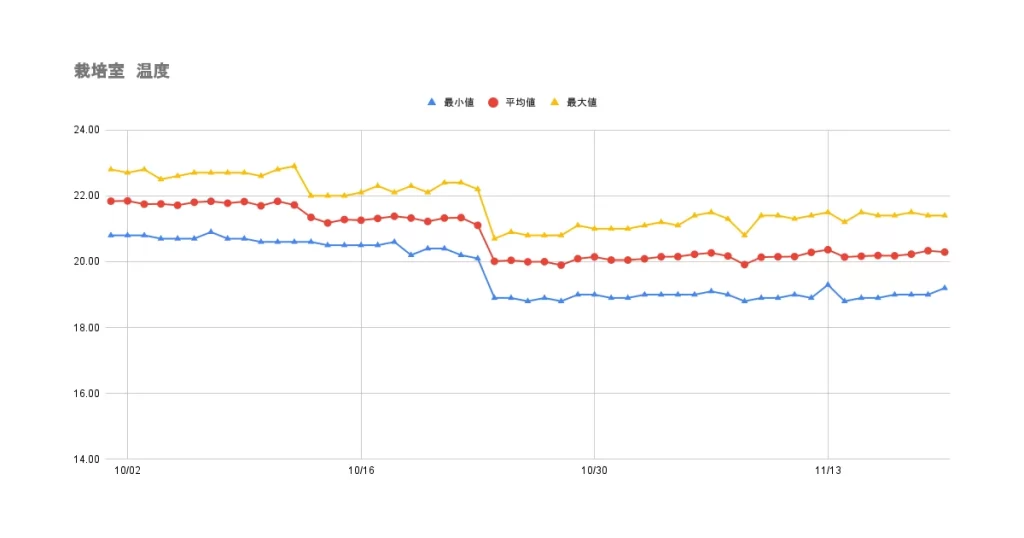
There is a lot of data worth recording in a vertical farm, but it falls roughly into three categories:
- Environmental data: air temperature, humidity, light intensity, CO2 concentration, nutrient solution temperature, EC, pH, and so on
- Cultivation data: variety, seeding date, harvest date, yield, number of defective seedlings, and so on
- Equipment data: lighting hours, HVAC setpoints, the nutrient program, and so on
Three things keep records trustworthy: calibrating your sensors on a regular basis so the data is accurate, recording every required item without gaps, and continuing to accumulate data over the long term.
Some operations introduce dedicated systems for recording, but in many cases a spreadsheet is enough. What matters is that the method is easy for floor staff and managers to read and easy to keep using over time.
The Analysis Process: Turning Data into Higher Yield
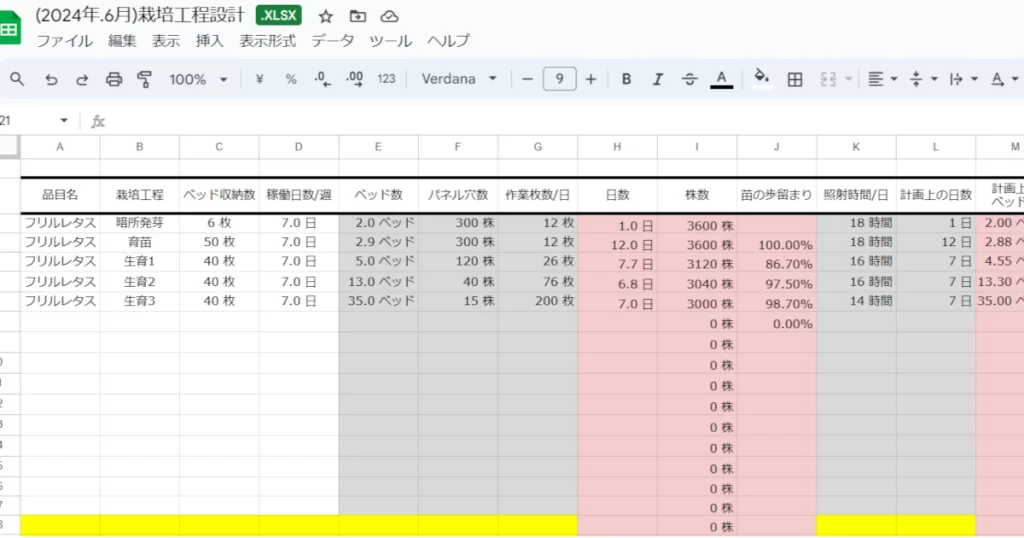
Follow these steps when analyzing data:
- Set a purpose: decide concretely what you want to find out (for example, raising yield or cutting cost)
- Collect the data: gather the data you need based on that purpose
- Visualize the data: use charts and tables to make the data easy to grasp at a glance
- Analyze and interpret: find relationships between variables, form hypotheses, and test them
- Put improvements in place: change the growing environment or management approach based on what the analysis shows
- Check the result: verify the effect of the changes and, if needed, run the analysis again
Data analysis is not a one-and-done exercise. The cycle of collecting and analyzing data and repeating improvements is itself what sharpens operational precision on the floor.
How to Think About Data Analysis That Actually Raises Yield
Data analysis is an indispensable skill for improving a vertical farm, but managers also need the knowledge and know-how to read the data.
Consider, for example, analyzing the percentage of trimming waste you have recorded.
If you stop at the impression that “there was a lot of waste,” it leads nowhere. Even from the data on trimming waste alone, you can read multiple dimensions: the pattern in which the waste was generated, the work quality of the trimmer that day, flaws in the cultivation process, and how densely the crop was planted.
Once you can read the pattern of generation, the work quality, the flaws in the cultivation process, and the planting density from trimming waste data, the range of improvement actions available to you expands dramatically.
At vertical farms that are producing results, the managers and operators deeply understand what drives profit, and they run the place on hard-won know-how of their own.
172 Hints for Making a Vertical Farm Profitable
Summary
The essence of using data in a vertical farm is not “measure and be done with it,” but embedding the cycle of recording, analyzing, and improving into how the floor runs. Continuously accumulating environmental, cultivation, and equipment data, together with the ability to read what each of those numbers means, connects directly to both yield and profit.
Even without specialized analysis tools or advanced statistics, improvement progresses through persistent recording and repeated hypothesis testing. What matters is building a culture on the floor that treats data as material for decisions. The shift from rule-of-thumb management to data-driven management is becoming one of the factors that decide the competitiveness of a vertical farm.